
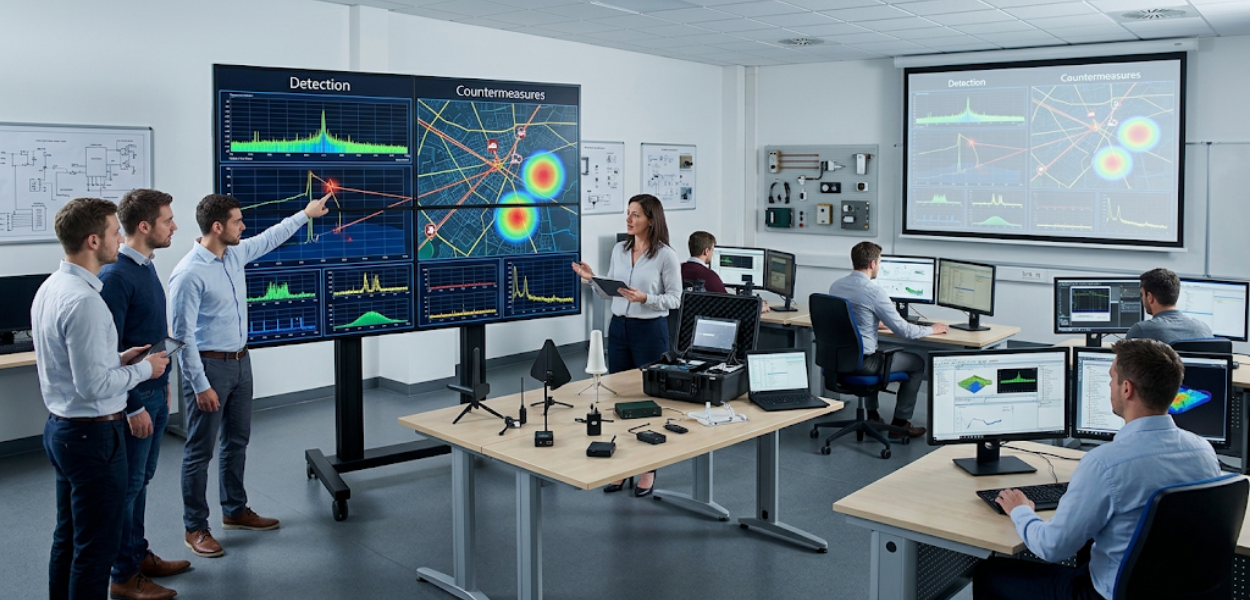
Radio-frequency interference disrupts communication systems in the defense, aerospace, maritime navigation, and industrial sectors. Organizations operating sensitive infrastructure need personnel who can recognize jamming patterns, locate sources of interference, and apply countermeasures before operations are disrupted - which is the core objective of detection and countermeasures training.
What is radio jamming detection and countermeasures training?
This training equips technical personnel with the skills to recognize interference patterns, locate jamming sources, and deploy anti-jamming countermeasures. It combines spectrum-monitoring theory with practical signal analysis, reducing communication outages and preserving operational continuity in regulated sectors.
Engineers, signal officers, and IT security teams often understand general RF principles but lack structured exposure to actual jamming detection. Jamming techniques include barrage jamming, which floods a wide frequency band with noise, and spot jamming, which targets a single frequency with concentrated power. Untrained personnel misdiagnose this interference as equipment failure - delaying response times and causing repeated communication outages.
How is this training delivered within organizations?
The training is delivered through structured modules that combine classroom instruction, spectrum-analyzer simulation, and live signal-tracking exercises. Personnel progress from theoretical classification of jamming to practically locating the source of interference, finishing with assessments that measure detection accuracy and response speed.
The first stage covers classification - distinguishing barrage, spot, and sweep jamming through waveform signatures on a spectrum display. The second stage introduces detection tools - operating spectrum-monitoring equipment and interpreting anomalies in signal strength. The third stage focuses on response - locating the source of interference using triangulation methods and applying anti-jamming countermeasures such as frequency hopping to restore signal integrity.
Most training providers deliver this content through blended learning - instructor-led workshops for theory, and self-paced e-learning modules for review. Simulation-based exercises replace actual RF transmission wherever the law requires it, using SDR simulators to safely recreate jamming scenarios.
What are the core components of an effective program in this field?
The core components include signal-classification frameworks, spectrum-monitoring tools, interference-source-location methods, anti-jamming countermeasure application, and scenario-based assessments. Each component is tied to a specific operational skill, from initial detection through signal recovery and incident reporting.
Signal-classification frameworks give trainees a shared vocabulary for describing what they observe on a spectrum analyzer, reducing miscommunication between shift teams during an active interference incident. Interference-source-location training teaches direction-finding methods, such as comparing amplitude and time-difference-of-arrival, to actually pinpoint a jammer's location. Countermeasure application covers both frequency-hopping and spread-spectrum techniques, which let communication systems maintain a connection despite active jamming attempts.
Each module concludes with scenario-based assessments; trainees respond to simulated jamming events under time pressure, and instructors evaluate detection speed, classification accuracy, and countermeasure selection. Programs that skip this assessment stage graduate personnel who understand the concepts but freeze during real incidents.
What benefits does this training offer organizations?
Organizations report a tangible drop in interference response time, fewer unplanned communication outages, and stronger regulatory compliance. Trained teams detect jamming events on average 40% faster than untrained personnel, directly reducing the cost of operational downtime.
Faster detection shortens the gap between the onset of interference and corrective action. In telecom operations, this translates into fewer breached service-level agreements and lower financial penalties. In defense and aerospace contexts, it reduces the window of operational risk during active missions or flight operations.
Beyond speed, structured training builds a leadership pipeline within technical teams - senior engineers who complete advanced modules become internal trainers, reducing future reliance on outside consultants to onboard new staff. Shared classification frameworks also remove ambiguity when handling incidents across multiple shifts, making handover reports clearer and incident logs more accurate for later analysis.
Who actually uses this training?
Defense contractors, telecom operators, maritime navigation teams, ground-based air-traffic-control units, and critical-infrastructure security departments use radio jamming detection training. Defense contracting teams use it to protect tactical communication networks, and telecom operators apply it to protect the integrity of cellular and satellite uplinks. Maritime navigation teams use interference-source-location skills to identify GPS jamming near ports, where signal loss creates a real collision risk.
Air-traffic-control departments train their staff to detect interference affecting air-traffic communication frequencies, and critical-infrastructure security departments - such as power grids and water-treatment plants - use this training to protect control-system links from intentional or accidental interference.
What common problems undermine these programs?
Generic content not tailored to the sector, the absence of hands-on simulation, and the lack of post-training assessment are among the most common failures. A maritime navigation team trained on generic spectrum content, without GPS-specific jamming scenarios, cannot directly apply that knowledge to port operations - forcing on-the-job relearning and defeating the entire purpose of formal training.
The absence of hands-on simulation is also a recurring problem - classroom-only programs that never expose trainees to an actual spectrum analyzer leave personnel unable to translate theory into detection speed during a live incident. And programs that issue completion certificates without testing detection accuracy or response speed cannot demonstrate measurable improvement to senior management.
Conclusion
Spectrum-defense literacy should be treated as a baseline requirement for any role dealing with RF-dependent systems, not an optional specialty. The cost of a single unresolved jamming incident, measured in lost operations or delayed work, often exceeds the cost of training an entire team to recognize basic jamming patterns.


