
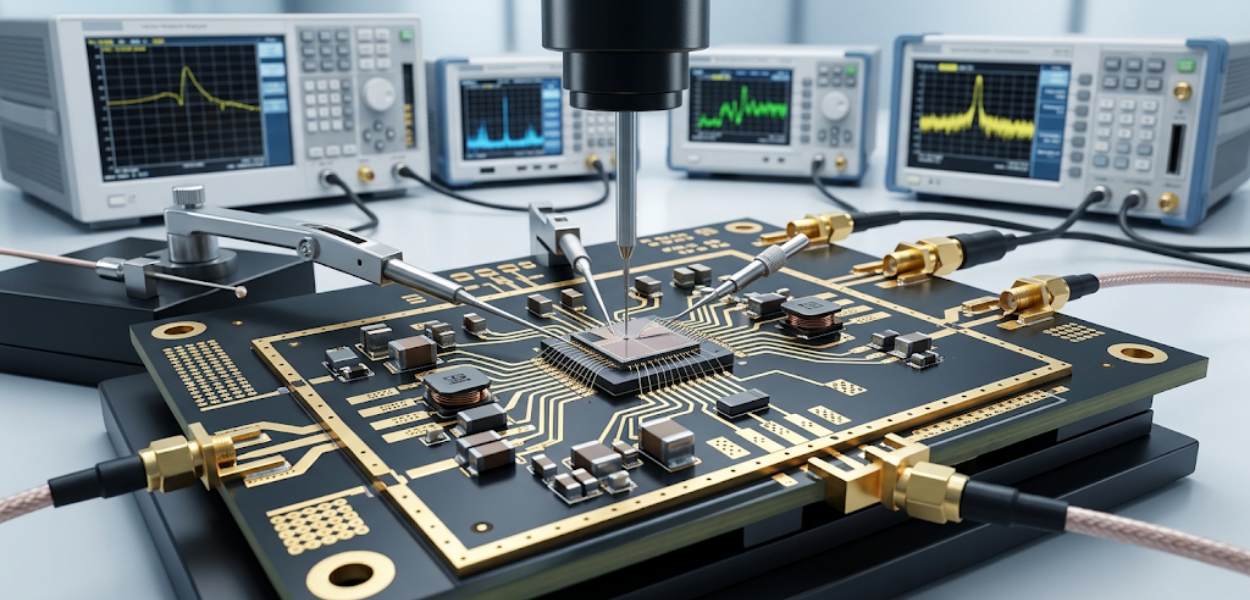
RF circuit and system design is a systematic process for designing, analysing, testing, and optimising radio-frequency electronic systems. In organisational work environments, this skill supports wireless and wired communications, aerospace, defence, automotive electronics, satellite systems, medical devices, and industrial connectivity.
For organisations, RF design training programmes address technical skill gaps that affect product development, system reliability, testing accuracy, and engineering productivity. Employees learn how circuit-level decisions affect complete RF systems.
Why Do Organisations Need RF Circuit and System Design Skills?
Organisations need RF design skills to reduce engineering errors, improve wireless system performance, shorten development cycles, and build consistent technical capability across engineering, testing, and R&D teams.
RF systems operate in high-frequency electrical environments, where small design errors affect signal quality, impedance matching, gain, noise, and power efficiency. The organisational skills gap appears when engineers understand individual components without sufficient knowledge of system-level design, so an engineer may understand how an amplifier works but lack practical experience in cascaded gain, noise figure, and impedance matching.
Training addresses this gap by connecting circuit theory to actual system application, establishing a shared technical framework for engineers in R&D, product engineering, testing, manufacturing, and quality assurance.
How Does the Training Work in Organisational Work Environments?
Corporate RF training follows a structured sequence that includes fundamentals, circuit analysis, system modelling, simulation, measurement, practical applications, assessment, and workplace application against specific performance requirements.
The process begins with a skills-gap assessment, after which training objectives are directly linked to job responsibilities: the research team needs deeper design and simulation capability, the testing team needs stronger measurement and troubleshooting skills, and the technical manager needs system-level understanding. Instructor-led workshops, e-learning modules, hands-on labs, blended learning, simulation, and case-based exercises can all be used, with each method serving a different learning requirement.
Implementation typically follows five stages: skills assessment to identify current competencies and gaps, learning design linking content to engineering responsibilities, hands-on application through calculations, simulations, and circuit examples, workplace application to actual engineering tasks, and performance measurement comparing indicators before and after training.
What Technical Components Should the Training Include?
Effective RF training combines scattering parameters, impedance matching, Smith charts, amplifiers, mixers, transmission lines, standing wave ratio, noise, gain, frequency response, and simulation and measurement.
Scattering parameters describe how RF networks respond to incident and reflected signals. The Smith chart is a graphical tool for analysing impedance relationships, used by engineers for impedance matching and transmission-line analysis. A low-noise amplifier is designed to increase signal strength while adding the least possible amount of noise, and it takes on particular importance at the receiver stage. Mixers combine or convert frequencies, supporting frequency conversion in receivers, transmitters, and radar systems. Transmission lines carry high-frequency signals between components, and their electrical behaviour differs from simple wires because impedance and reflections matter. Standing wave ratio refers to the relationship between forward and reflected waves on a transmission line.
How Are RF Design Tools and Methods Applied in Work Projects?
RF design methods are applied through specification analysis, architecture development, component selection, circuit modelling, simulation, prototype testing, measurement, troubleshooting, optimisation, and final verification.
A typical work project begins with system specifications: operating frequency, bandwidth, gain, noise requirements, input and output impedance, and power levels. Engineers then develop an architecture linking functional blocks, such as an antenna interface, filter, low-noise amplifier, mixer, and intermediate-frequency stage. Each block requires technical analysis of gain, noise contribution, and impedance matching. Simulation provides an intermediate verification stage before building the physical prototype, and practical measurement then verifies the design using equipment such as network analysers, spectrum analysers, and signal generators.
What Are the Benefits of RF Design Training for Engineering Teams?
Training improves technical consistency, troubleshooting capability, design accuracy, testing efficiency, cross-disciplinary communication, and system-level decision-making.
The first benefit is improved technical consistency, with employees using shared terminology, calculation methods, and design procedures. The second benefit is stronger troubleshooting, as engineers can trace performance problems from system-level symptoms back to individual circuits. The third benefit is improved design efficiency, by identifying unsuitable configurations early and reducing prototype iteration. Training also supports better collaboration across different engineering functions.
Where Can Organisations Use This Training?
It is used in telecommunications, aerospace, defence, automotive electronics, satellite communications, wireless networks, medical technology, industrial electronics, and R&D.
Telecommunications teams use this knowledge in wireless infrastructure, base stations, and antennas. Aerospace and defence organisations apply it to radar, satellite communications, and navigation. Automotive electronics teams use it in connected vehicles and radar sensors. Medical technology organisations use these principles in certain diagnostic and monitoring applications. Industrial companies apply it to remote monitoring, industrial connectivity, and wireless sensors.
What Common Problems Reduce the Effectiveness of RF Training?
Training becomes ineffective when it relies on general theory, separates components from system behaviour, neglects practical measurement, uses unsuitable examples, and measures attendance rather than performance and application.
Excess theoretical content without practical application is a common problem, because engineers need to understand the equations but also to interpret measurements and make design decisions. Teaching components in isolation is another problem, because understanding an amplifier or a mixer on its own does not demonstrate full competence in system design. Insufficient simulation, generic corporate training, neglected measurement, and weak assessment are all factors that reduce effectiveness.
How Should Organisations Choose the Right Learning Approach for RF?
Organisations should select training according to employee roles, technical skill gaps, system complexity, practical requirements, implementation constraints, and measurable business outcomes, rather than using a generic training structure.
A skills matrix provides the starting point, mapping employee level against competencies such as RF fundamentals, circuit design, scattering parameters, simulation, and measurement. Training depth should match job responsibilities: junior engineers need strong fundamentals, experienced engineers need deeper system integration and optimisation, and managers need enough technical understanding to evaluate engineering decisions. The delivery approach should align with operational requirements: e-learning supports distributed teams, while workshops support intensive technical instruction.


