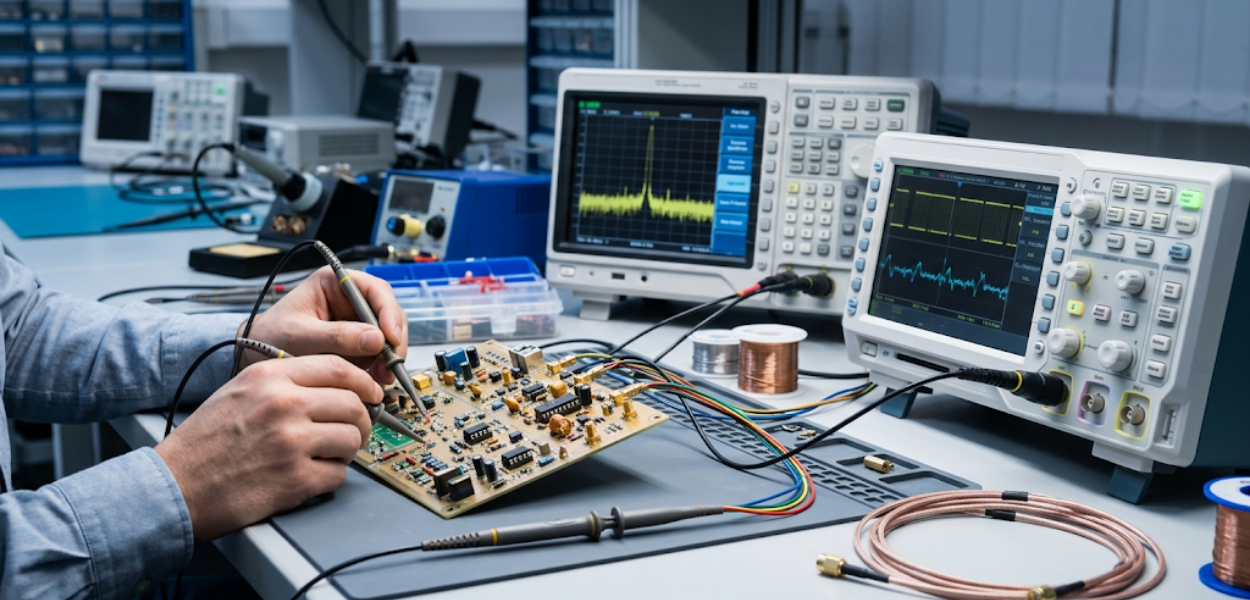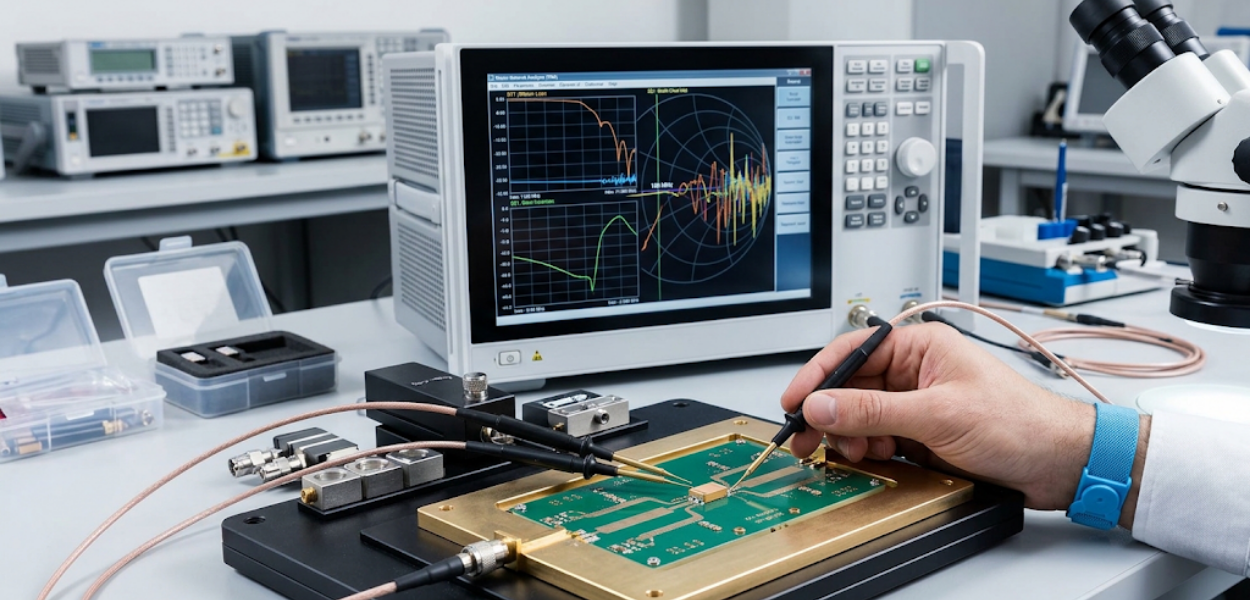

RF engineering teams need more than theoretical circuit knowledge, because practical systems depend on impedance matching, signal transmission, gain, noise, reflection, frequency conversion, and reliable integration between components. This course addresses these requirements through structured technical learning that connects circuit behavior to system performance, and is designed for professionals in wireless communications, communications infrastructure, electronic products, testing, and RF operations.
What problem does RF circuit and system design training address?
The program addresses practical skills gaps related to impedance, transmission lines, scattering parameters, the Smith chart, gain, noise, matching, reflection, frequency conversion, testing, and system integration.
RF systems become more complex to analyze as frequency increases, and component characteristics, connections, parasitic effects, and impedance mismatches can affect the final system even when individual components appear correctly specified. Professionals need to understand circuit behavior at the component level and system behavior at the overall level, and the program addresses this through a sequence covering transmission lines, impedance matching, Smith chart techniques, scattering parameters, VSWR, signal amplifiers, mixers, and filters.
Why is the program structured progressively around RF engineering skills?
The curriculum moves from RF fundamentals to transmission behavior, impedance matching, network analysis, active circuits, noise, performance evaluation, troubleshooting, and system integration.
Starting with advanced system problems without establishing the fundamental relationships between frequency, impedance, power, bandwidth, attenuation, and noise can create gaps in engineering reasoning. The early modules introduce RF signal characteristics and system architecture, then transmission lines introduce concepts of characteristic impedance, propagation, reflection, termination, and attenuation. The sequence then addresses impedance matching and the Smith chart, followed by scattering parameters, which provide a framework for network analysis.
What will participants learn from the course curriculum?
Participants develop measurable capabilities in RF analysis, impedance matching, transmission line evaluation, interpreting scattering parameters, using the Smith chart, analyzing VSWR, evaluating amplifiers and mixers, and analyzing noise and testing. The curriculum consists of 14 modules covering the complete sequence from fundamentals to practical applications.
RF fundamentals and signal behavior: Participants learn how RF signal behavior relates to frequency, wavelength, power, impedance, bandwidth, gain, attenuation, and noise, and the practical differences between circuit behavior at low and high frequencies.
Transmission lines, matching, and the Smith chart: Transmission line analysis develops the ability to study characteristic impedance, propagation, reflection, and termination. The Smith chart module applies these principles to practical impedance analysis.
Scattering parameters and VSWR: These provide a structured method for examining RF network performance, and VSWR training connects measurement results to impedance mismatch and reflected power.
Low-noise signal amplifiers and mixers: The amplifier module addresses gain, bandwidth, noise figure, linearity, and stability. The mixer module covers frequency conversion, conversion gain, image frequencies, and unwanted mixing products.
RF noise and system performance: This addresses thermal noise, noise sources, and noise figure, which is particularly important when evaluating receiver sensitivity.
Testing, troubleshooting, and optimization: The later modules focus on measurement planning, RF test equipment, and signal analysis, and participants study issues such as high VSWR, impedance mismatch, and insufficient gain.
How does Arab British Fellowship Training Academy deliver this training?
The training is designed around practical professional development, combining structured technical instruction with applied sessions, exercises, simulations, and testing scenarios.
Hands-on training can be organized around technical scenarios such as analyzing a mismatched transmission path, interpreting scattering parameters, evaluating amplifier performance, and calculating gain and noise contributions. Workshops can focus on specific engineering problems, online or hybrid training can support distributed engineering teams, and on-site corporate training can align with existing engineering operations. The Academy provides training in locations including London and Dubai, allowing organizations to accommodate location-related implementation requirements.
What measurable learning outcomes should participants achieve?
Successful participants should be able to analyze RF circuits, interpret key parameters, apply matching techniques, evaluate active components, identify performance problems, and interpret measurements.
They should be able to explain the relationship between impedance, reflection, VSWR, return loss, and transmission performance, use Smith chart techniques, interpret scattering parameters when evaluating networks, understand how low-noise amplifier characteristics affect receiver performance, and evaluate mixers based on frequency conversion, unwanted products, and isolation.
What are the program's schedule, cost, and eligibility considerations?
The program includes dates scheduled throughout the year, with published pricing that varies by number of participants and selected city. RF, communications, electronics, testing, and engineering professionals are the primary participant category. Pricing varies by number of participants and decreases proportionally as more participants from the same organization enroll, which encourages group registration.
How does enrollment in the program work?
Enrollment should begin by confirming the participant profile, preferred location, available program date, training requirements, number of participants, and applicable fees, before completing the registration procedures.
The decision-making process should start with aligning competencies, and organizations can identify the technical responsibilities the participant needs to perform after training and compare them against the curriculum modules. The next step is confirming implementation requirements: whether the training will be attended by an individual or a group, and whether London, Dubai, online, or hybrid suits the organization's requirements. For organizational groups, HR managers and technical managers can identify the targeted post-training responsibilities, such as RF design analysis, equipment testing, or system integration.