
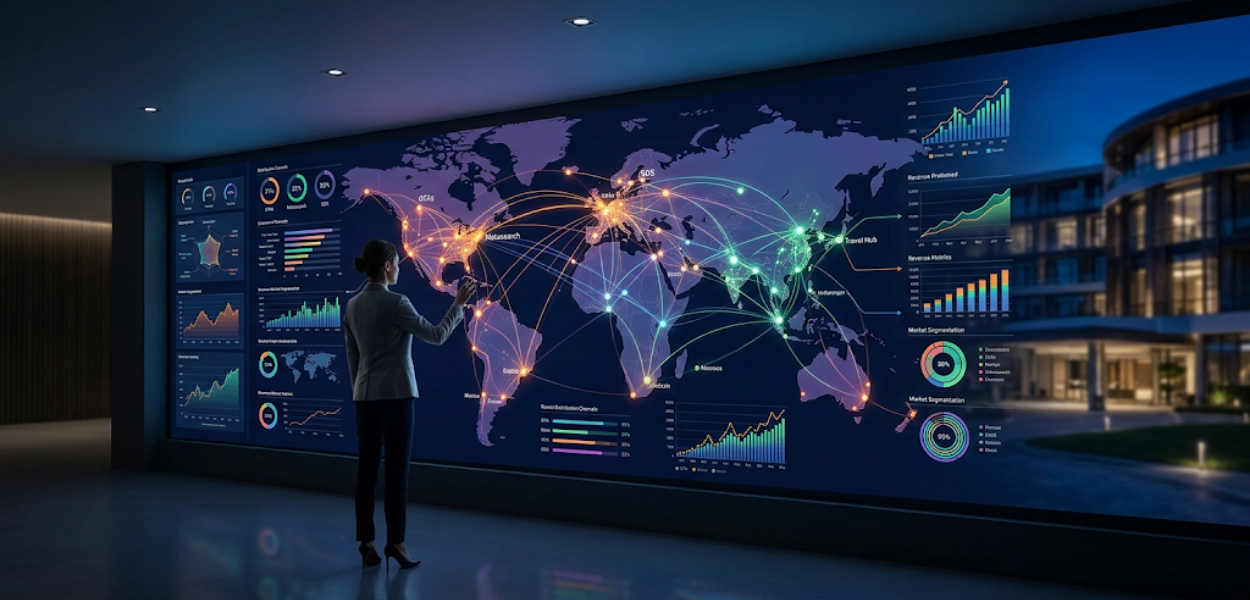
Hotel sales and marketing connects demand generation, room distribution, pricing, and guest acquisition. The strongest strategy combines direct channels, online travel agencies, global distribution systems, and digital marketing with revenue management to achieve measurable commercial goals.
Hotel sales and marketing sits within the broader hospitality and tourism management environment, because hotels compete through distribution, positioning, guest experience, and commercial performance. Understanding the sector's wider context helps managers distinguish between marketing activities, revenue decisions, and distribution decisions.
What are the main channels used in hotel sales and marketing?
Hotels use direct websites, online travel agencies, global distribution systems, specialised search engines, social media, corporate accounts, and local partnerships to reach different customer segments while controlling cost, availability, and brand consistency.
A hotel's distribution channel is the pathway through which the property reaches potential guests and converts demand into bookings, and the channel mix typically includes the hotel's own website, the booking engine, online travel agencies, global distribution systems, wholesalers, tourism partnerships, corporate accounts, and travel agencies.
Direct channels give hotels greater control over the customer relationship; the website, booking engine, email database, and loyalty programme help support direct acquisition, and also provide customer data that helps commercial teams understand booking behaviour and repeat demand.
Online travel agencies provide access to large audiences and international markets; their strength lies in reach, visibility, and ease of completing transactions, but their commercial cost includes commissions and the possibility of reduced hotel control over the direct customer relationship. Corporate sales work differently; hotels develop negotiated rates and relationships with companies that generate recurring business travel demand, and sales teams measure business volume, room nights, average daily rate, and account profitability rather than relying solely on website conversions.
Social media and content marketing support demand generation rather than functioning as independent booking channels, and their value increases when campaigns are linked to specific guest segments, particular destinations, demand seasonality, or the experiences the hotel offers. This is why the right channel mix depends on the market segment, property type, location, seasonality, and commercial goals; a business hotel needs a different distribution structure than a resort targeting international leisure travellers.
How does a global distribution system work in hotel room distribution?
A global distribution system connects hotels to travel agencies, corporate travel buyers, and professional intermediaries through availability, pricing, and centralised inventory, expanding market reach while requiring accurate information, pricing, and inventory management across connected channels.
A global distribution system is a technical infrastructure used to distribute travel inventory to professional travel sellers, and in the hotel sector, connecting to this system allows travel agencies and corporate travel management companies to search for and book rooms using centralised hotel information. Major global distribution system environments include systems such as Amadeus, Sabre, and Travelport, and their commercial importance increases when hotels rely on business travel, international travel agency networks, corporate accounts, and meetings.
Distributing rooms through a global distribution system requires ongoing operational accuracy; available rooms, rate plans, cancellation terms, property information, and booking rules must stay synchronised, and an incorrect rate or an unavailable room can lead to booking failures and weaken relationships with travel buyers.
This is why a global distribution system isn't just another booking website, but part of the hotel's professional distribution infrastructure; revenue managers determine which inventory and rates should be made available, while sales teams use this channel to develop relationships with travel agencies and corporate travel buyers. For HR and L&D teams, global distribution system skills represent a specific functional capability; employees responsible for reservations, distribution, sales, or revenue management need to understand how inventory moves between the hotel's system and external distribution networks. Training effectiveness can be measured through booking accuracy, channel performance, response speed, revenue contribution, and a reduction in distribution errors.
How should hotels evaluate direct bookings versus intermediaries?
Hotels need to evaluate channels based on profitable revenue, customer acquisition cost, booking value, cancellation behaviour, customer data ownership, and strategic reach. Direct bookings provide greater control, while intermediaries provide market access, visibility, and additional demand.
The direct-versus-intermediary channel decision isn't just about commission; the hotel needs to understand the full economics of each booking source. Direct bookings typically give the hotel greater control over the guest relationship; the hotel controls the website presentation, promotional messaging, loyalty incentives, and post-booking communication, and retains more customer information it can use to build future relationships.
Intermediaries provide a different kind of value; an online travel agency can put the hotel in front of millions of potential travellers and provide established international demand, and for an independent hotel entering a new market, this reach can be commercially significant.
This is why the right question isn't "which channel is best overall," but "which channel delivers the required demand at an acceptable acquisition cost." Hotels need to analyse a set of indicators, including conversion rate, average daily rate, revenue per available room, cancellation rate, commission, customer acquisition cost, repeat booking rate, and net revenue after distribution costs. A hotel can also assess channel performance by segment; an online travel agency might perform strongly with international leisure travellers, while corporate sales might deliver higher value on weekdays.
This analysis provides a more reliable basis for allocating resources across channels; marketing teams generate demand, sales teams develop accounts and relationships, while revenue teams determine how inventory and pricing should respond to that demand.
How does revenue strategy affect hotel sales and marketing?
Revenue strategy balances room rates, inventory, demand forecasting, and customer segmentation against expected market conditions, and transforms hotel sales and marketing from separate promotional activities into commercial demand management measured by occupancy, rate, revenue, and profitability.
Revenue management is the process of selling the right room to the right customer through the right channel, at the right price, at the right time. Hotels operate with highly perishable inventory; an unsold room on a given night can't be stored and sold later, which is why demand forecasting and rate management matter so much.
Revenue managers study past booking patterns, current bookings, competitor rates, events, seasonality, cancellations, booking lead time, and market demand, then adjust rates and inventory controls according to the expected demand level. Sales and marketing must operate within this commercial system; a marketing campaign that generates demand during a period of low occupancy can support revenue performance, but becomes less efficient when it generates high demand while the hotel is already near capacity.
Customer segmentation is a core element of the strategy; leisure travellers, corporate guests, groups, wholesalers, and last-minute bookings have different booking patterns and price sensitivity. Key performance indicators include occupancy, average daily rate, revenue per available room, and overall operational performance; revenue per available room combines occupancy and average daily rate to give a broader picture of room revenue performance.
This is why marketing teams need to understand commercial goals before launching campaigns, and revenue teams need to understand customer acquisition activities, because pricing decisions affect demand generation. This integration is one of the most important functional capabilities required in modern hotel commercial operations.
What digital marketing methods support hotel revenue performance?
Hotel digital marketing achieves its best performance when search visibility, paid advertising, content, email, social media, reputation management, and conversion optimisation work together around defined customer segments, with every activity linked to booking behaviour rather than just views or engagement.
Hospitality marketing has become increasingly data-driven; travellers compare hotels, rates, reviews, locations, and experiences across multiple digital touchpoints before completing a booking. Search engine optimisation helps hotels reach users actively searching for destinations, accommodation, and travel experiences, and paid advertising can target high-intent searches when direct booking behaviour is more likely.
Content marketing supports the early stages of the customer journey; destination guides, local experiences, seasonal recommendations, and hotel information can attract users before they're ready to book. Email marketing works differently because it relies on an existing customer relationship; hotels can use customer data to communicate relevant offers, loyalty benefits, seasonal campaigns, and post-stay engagement.
Reputation management also affects commercial performance; reviews affect trust and can influence the comparison stage, which is why operational teams are directly connected to marketing outcomes, since service quality contributes to the hotel's digital reputation. Conversion optimisation focuses on removing obstacles between interest and booking; website speed, room information, rate clarity, cancellation terms, payment options, and mobile usability all affect the booking experience.
For organisations, these capabilities create clear training needs; marketing staff need digital acquisition skills, sales teams need customer segmentation and account management skills, and revenue teams need data analysis and forecasting skills. Training effectiveness should be linked to business indicators, such as website conversion, contribution to direct bookings, campaign revenue, acquisition cost, and repeat booking performance.
What should hotels consider when choosing a sales and marketing training approach?
Training should be chosen based on commercial responsibilities, current skill gaps, level of technology engagement, and measurable performance requirements, and should connect channel management, sales, digital marketing, and revenue principles to understand commercial impact.
The first consideration is employees' skill gap; a hotel with strong operational teams but lacking digital acquisition capability needs a different approach than a hotel with experienced marketers whose revenue management knowledge is limited. The second consideration is how well the training fits the role; front-desk staff don't need the same level of global distribution system knowledge that distribution managers need, sales staff need account development and negotiation skills, while revenue managers need stronger analytical and forecasting capabilities.
The third consideration is the training delivery method; in-person training supports structured discussion and collaborative case analysis, workshops provide opportunities to work through pricing, segmentation, and channel scenarios, and online training offers greater flexibility for geographically distributed and international hotel groups. The fourth consideration is commercial application; training should use realistic hotel cases rather than isolated theoretical concepts, and participants should be able to analyse occupancy patterns, channel performance, pricing decisions, corporate accounts, and digital campaigns.
A professional programme such as Hospitality, Tourism, and Events can provide broader sector knowledge when organisations need to understand how commercial functions interact across hospitality and tourism operations.
The final consideration is measurement; HR and L&D teams need to establish baseline performance before training and define measurement indicators afterward, which might include booking accuracy, channel contribution, sales conversion, revenue performance, and forecast quality. When the development need is specifically focused on hotel marketing, the decision comes down to whether employees need specialised training rather than general sector knowledge; a specialised programme should cover customer segmentation, hotel positioning, digital acquisition, distribution channels, promotional planning, and performance measurement, and clarify how marketing decisions connect to revenue strategy rather than treating marketing as a separate promotional activity.
How do HR teams measure the commercial value of hotel sales and marketing training?
HR teams can measure training value by linking learning outcomes to operational and commercial indicators; useful indicators include sales conversion, distribution accuracy, direct booking contribution, revenue performance, forecast quality, and pre- and post-programme capability assessments.
Training evaluation should start before employees enter the programme; managers can establish current competency levels through assessments, performance data, manager feedback, and operational error rates. A distribution team suffering from recurring inventory discrepancies, for example, can establish a baseline error rate, and after training the organisation can compare error frequency, correction time, and booking reliability.
Sales teams can be evaluated through account generation, conversion rates, room nights, and revenue contribution, and marketing teams can be evaluated through campaign efficiency, conversion, acquisition, and customer acquisition cost. Revenue teams need different indicators; forecast accuracy, pricing decisions, occupancy performance, and revenue per available room provide stronger evidence of commercial capability.
Learning should also measure behavioural change; employees need to demonstrate the ability to interpret channel data, choose appropriate distribution methods, explain pricing decisions, and link marketing activities to revenue goals. For senior management, the strongest evidence comes from combining capability indicators with business outcomes; training doesn't operate in isolation from market conditions, but organisations can set measurable performance expectations and track improvement over time.
This process leads to a more disciplined approach to professional development; instead of measuring training through attendance or programme completion alone, hotels can assess whether employees are applying commercial knowledge in decisions that affect sales, distribution, customer acquisition, and revenue performance.


