
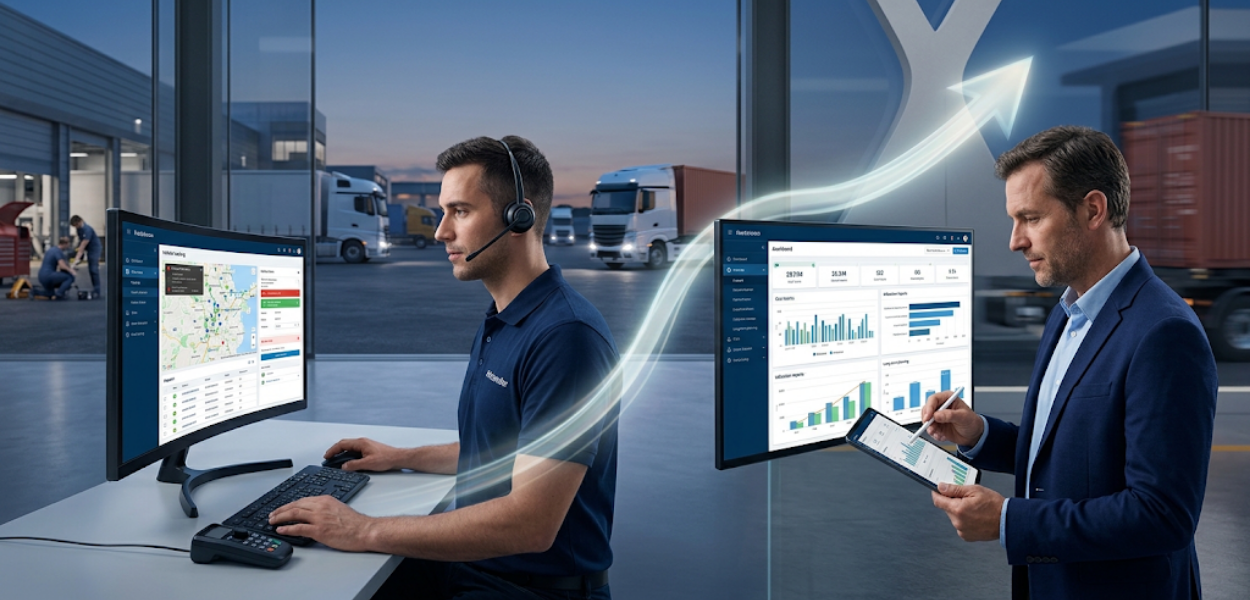
What is the difference between a fleet supervisor and a fleet manager?
A fleet supervisor handles day-to-day coordination of fleet operations, while a fleet manager bears responsibility for broader operational performance, compliance, cost control, staff development, strategic planning, and management of vehicles and transport operations.
The fleet supervisor is primarily responsible for coordinating vehicle movement, availability, and operational condition, and the role links drivers, vehicles, maintenance teams, transport planners, customers, and internal departments, focusing on day-to-day operational oversight.
The fleet manager, on the other hand, works at a broader scope; their responsibilities include fleet strategy, budgets, compliance, vehicle replacement, maintenance policies, driver performance, supplier management, risk management, and process improvement.
This distinction becomes important when organizations set career progression paths or identify employees' skills gaps; a competent fleet supervisor has a practical foundation in scheduling, vehicle utilization, driver coordination, documentation, and responding to operational exceptions, and a fleet manager needs these fundamentals alongside financial, analytical, leadership, strategic, and compliance skills.
The difference also affects how performance is measured; the fleet supervisor tracks daily indicators such as vehicle availability, route adherence, driver allocation, maintenance status, and delivery exceptions, while the fleet manager evaluates higher-level indicators such as total fleet cost, fuel consumption, utilization rates, maintenance expenses, accident rates, compliance level, and return on fleet investment.
For example, a logistics company managing 150 vehicles needs supervisors who maintain daily visibility of vehicle movement, and the fleet manager uses this operational data to determine the need to replace vehicles, redesign routes, change suppliers, or train drivers.
How does the fleet supervisor contribute to organizational operations?
The fleet supervisor translates transport plans into daily operational actions by coordinating vehicles, drivers, schedules, maintenance requirements, documentation, and exceptions, while maintaining accurate operational information that supports management decisions and performance monitoring.
Fleet supervision is a coordination function; the supervisor tracks what is happening within the fleet and responds as operating conditions change. Their responsibilities typically include vehicle allocation, driver scheduling, trip monitoring, dispatch coordination, maintenance communication, fuel monitoring, transport documentation management, and incident reporting. They maintain operational visibility by gathering information from drivers, tracking systems, maintenance departments, and transport planners.
The role requires strong communication skills, because fleet operations depend on many interconnected factors; a vehicle breakdown affects the schedule, a driver's absence affects allocation, delayed maintenance affects vehicle availability, and a route disruption affects delivery performance. Technology supports this work, as fleet management systems, vehicle tracking platforms, maintenance databases, fuel monitoring tools, and digital reporting systems provide the information the supervisor uses to coordinate operations.
This is why fleet-supervisor development programs focus on building practical operational competence, through dispatch simulations, scheduling exercises, vehicle-allocation scenarios, incident-response exercises, and assessments based on actual fleet data. This process provides a stronger operational foundation for moving into supervisory and managerial positions.
What responsibilities distinguish a fleet manager from a fleet supervisor?
The fleet manager bears responsibility for fleet performance across the entire organization, including strategy, costs, compliance, asset lifecycle, supplier relationships, staff performance, risk, sustainability, and continuous improvement of transport operations.
Fleet management goes beyond day-to-day coordination; the manager sets the policies and systems that determine how the fleet will operate over months and years. They set fleet plans according to business needs, including the number of vehicles, their specifications, replacement cycles, ownership models, maintenance arrangements, and operating requirements.
Financial management is another key difference; the manager tracks the costs of vehicle purchase, leasing, fuel, maintenance, insurance, depreciation, and administrative expenses. Compliance also falls within the management function, from vehicle inspections, driver documentation, working-hours requirements, safety procedures, maintenance records, and regulatory reporting.
Supplier management is another responsibility; fleet managers evaluate maintenance providers, leasing companies, fuel suppliers, tracking-system providers, and other external partners. Leadership also matters, because the manager sets performance expectations, reviews key performance indicators, identifies capability gaps, and coordinates training interventions.
This creates a clear career-progression path; the fleet supervisor first develops operational experience, and then comes the stage of supervision, analysis, budget management, compliance, leadership, and strategic planning.
How does fleet supervisor training support the transition to fleet management?
Fleet-supervisor training builds operational capability through structured learning in scheduling, compliance, fleet systems, driver coordination, maintenance, reporting, and incident management, which lays the foundation for broader supervisory and managerial responsibilities.
Effective corporate training starts with a skills-gap assessment; the organization identifies the capabilities required for the current role and compares them to the employee's actual performance, and the assessment should examine operational accuracy, communication, technology use, documentation management, problem-solving, compliance awareness, and understanding of key performance indicators.
Training then follows a structured sequence: the first step is assessing operational capability, through performance records, supervisor feedback, evaluations, and operational performance indicators — the organization can review dispatch errors, vehicle downtime, documentation errors, response times, and schedule deviations over 90 days. The second step is building technical knowledge, from fleet terminology, vehicle categories, maintenance processes, transport documentation, compliance requirements, scheduling principles, and fleet-management technologies.
The third step is applying knowledge through simulation; a training scenario might present a vehicle breakdown, a driver shortage, an urgent delivery, a maintenance conflict, or a route disruption, and the trainee must choose the appropriate response. The fourth step is measuring workplace performance, by comparing operational indicators to a baseline after 30, 60, and 90 days. The fifth step is introducing managerial capabilities, for employees ready to advance, from budgeting, KPI management, supplier management, risk management, leadership, and strategic fleet decision-making.
This phased approach prevents organizations from treating fleet management as a single technical skill, and instead views the role as a combination of operational, analytical, financial, leadership, and compliance capabilities.
What skills are needed to move from fleet supervisor to fleet manager?
Career progression requires moving from coordinating tasks to making decisions and taking on responsibility, while building capabilities in fleet analysis, financial oversight, compliance, leadership, supplier management, risk assessment, workforce planning, and long-term asset strategy.
Fleet-supervisor competency provides the operational foundation, while fleet-manager competency expands this foundation to include organizational decision-making. Important skill areas include fleet planning, transport operations, financial analysis, compliance management, driver performance, maintenance strategy, supplier management, risk management, data interpretation, and leadership.
Fleet analysis gains particular importance, because it involves turning operational data into decisions; common key performance indicators include vehicle utilization, fleet availability, fuel consumption per kilometer, maintenance cost per vehicle, downtime, accident rate, on-time delivery rate, and total cost of vehicle ownership. Total cost of ownership measures the full economic cost of operating the asset, from purchase, financing, fuel, maintenance, insurance, depreciation, administration, and disposal.
The manager also needs financial knowledge; a decision to replace 20 vehicles, for example, requires analyzing purchase costs, maintenance trends, fuel efficiency, downtime, residual value, and operational needs. Leadership becomes more important as the fleet grows, and the manager coordinates drivers, supervisors, maintenance teams, administrators, suppliers, and key stakeholders.
What should fleet manager qualifications and development paths include?
A structured qualification path should combine transport operations, fleet legislation, financial management, fleet technologies, KPI analysis, risk management, leadership, procurement, sustainability, and practical assessment based on workplace scenarios and operational outcomes.
Organizations should not rely on job titles alone when selecting development programs; the curriculum must align with the fleet manager's actual responsibilities. Core areas include fleet operations, vehicle lifecycle management, transport compliance, maintenance planning, driver management, procurement, financial oversight, risk management, data analysis, leadership, and strategic planning, and these should be evaluated according to the organization's specific requirements — a company managing a 500-vehicle commercial fleet has different development requirements than a healthcare organization managing 40 service vehicles.
Assessment methods should also reflect workplace conditions; written tests assess knowledge, case studies assess analysis, simulations assess decision-making, role-play assesses communication, and practical projects assess implementation ability. The development path can use three stages: the first focuses on operational oversight, the second develops supervisory and analytical capabilities, and the third develops strategic fleet management. This model gives HR and L&D teams a practical structure for succession planning and measurable criteria for determining an employee's readiness for greater responsibilities.
What are the most effective learning methods for fleet operations training?
Fleet training achieves the best results when it combines classroom instruction, digital modules, case studies, practical exercises, simulation, role-play, assessments, and practical projects, in order to link technical knowledge to operational decision-making.
Workshops are useful for complex operational concepts; trainers can study fleet incidents, maintenance decisions, scheduling conflicts, and compliance cases with participants. Digital modules support the delivery of standardized knowledge, and suit policies, terminology, regulatory principles, documentation procedures, and introductory technical concepts. Hybrid learning combines the two approaches, so employees complete knowledge modules digitally and use live sessions for practical application.
Simulation gains particular importance in fleet supervision; a training scenario might present 10 vehicles, 12 drivers, two maintenance constraints, an urgent delivery, and a route disruption, and the trainee must allocate resources while maintaining operational priorities. Role-play supports communication skills, so one participant can play the role of a driver reporting a breakdown, and another can play the role of the supervisor responsible for coordinating the response. Assessments provide measurable evidence of competence, through knowledge tests, scenario evaluations, practical exercises, and workplace performance reviews.
How do organizations measure the business impact of fleet training?
Organizations must measure training impact through operational performance indicators, behavioral assessments, cost indicators, compliance outcomes, productivity measures, and career-development data over defined review periods — 30, 60, and 90 days.
Measuring training ROI requires a measurable baseline; before training, the organization records specific indicators, and after training, the same indicators are reviewed at set intervals. For example, a company can measure dispatch errors before and after training supervisors, and compare vehicle downtime, fuel consumption, maintenance scheduling accuracy, incident response time, and documentation errors.
A fleet-manager development program can use managerial indicators, from maintenance cost per vehicle, total fleet operating cost, vehicle utilization, supplier performance, accident rates, and replacement-planning accuracy. Productivity measures should link training to operational outcomes; if a supervisor manages 40 vehicles and improves scheduling accuracy, the organization can measure the change in vehicle downtime and the number of trips completed daily.
Employee development is another indicator; organizations can track the proportion of supervisors who move into supervisory or managerial positions within 12, 24, or 36 months. Retention rates also matter in workforce planning, and a defined development path provides clear benchmarks for employees and a structured path for building internal talent.
Where are fleet supervision and management capabilities used?
Fleet supervision and management capabilities are used in logistics, supply chains, shipping, construction, healthcare, public utilities, retail, manufacturing, utilities, and field services sectors that rely on vehicles for core operations.
Priorities differ depending on the operating environment; in logistics, fleet teams focus heavily on delivery schedules, vehicle utilization, route efficiency, and customer service. In healthcare, fleet operations support patient transport, medical supply distribution, mobile services, and emergency response. In construction, managers coordinate commercial vehicles, equipment transport, site requirements, maintenance, and driver availability.
In retail, fleets support distribution between warehouses, stores, and customers. In manufacturing, transport operations link production facilities to suppliers, warehouses, and distribution centers. In utilities, vehicle availability directly affects field-service productivity, and delays can prevent technicians from reaching service locations. Public-sector fleets need strong attention to compliance, procurement, cost control, asset utilization, and accountability.
The common requirement across all these sectors is operational reliability; organizations need vehicles and drivers to support business operations without creating unnecessary costs, downtime, compliance risks, or productivity losses.
What common problems reduce the effectiveness of fleet training?
Fleet training becomes ineffective when programs are generic or disconnected from operational performance indicators, delivered without a skills-gap analysis, assessed without practical evidence, or treated as a one-time activity rather than a continuous system for capability development.
Generic training is one of the most common problems; a program that ignores fleet size, vehicle type, regulatory environment, technology, and operating model provides limited workplace value. Another problem arises when measurable objectives are absent; employees may complete training successfully without any change in their operational behavior.
Training also fails when direct managers are not involved, because supervisors need to reinforce new procedures and monitor their application in the workplace. The absence of post-training measurement leads to another gap; without reviews at 30, 60, and 90 days, organizations cannot prove whether the learning changed operational performance or not.
There is also a misconception that fleet management is only about vehicles; fleet performance depends on people, processes, technology, finance, suppliers, compliance, and data together. Career progression becomes unclear when organizations do not distinguish between supervisor responsibilities and manager responsibilities, which leads to inconsistent development opportunities. A structured competency framework solves this problem by defining the knowledge, skills, behaviors, and performance evidence required at each career stage.
How do HR and L&D teams build a career path for fleet management?
HR and L&D teams should define fleet roles by competency level, identify skills gaps, allocate appropriate learning, assess practical performance, review key performance indicators, and link successful development to progression into supervisory and managerial responsibilities.
The path should start with role analysis; organizations define the responsibilities of fleet supervisors, senior supervisors, managers, and fleet managers, and each role is assigned measurable competency requirements. The next step is skills-gap analysis, evaluating current employees against these requirements. Training is then tailored to the gap; operational weaknesses need technical development, leadership gaps need managerial training, and analytical weaknesses need development in KPIs and data interpretation.
The Logistics, Supply Chains, and Shipping program provides a suitable institutional context for developing capabilities that link fleet operations to broader transport and supply-chain performance. Career progression should be based on demonstrated competence, not just training attendance; employees must demonstrate their ability to analyze operational data, manage incidents, control costs, apply compliance requirements, lead teams, and make evidence-based decisions.
This creates a transparent workforce-development system and supports succession planning; instead of hiring every fleet manager externally, organizations can identify supervisors who have the operational foundation and develop the additional competencies required for management.
What does successful fleet-capability development look like?
Successful fleet-capability development produces greater clarity in responsibilities, stronger operational control, better visibility of performance indicators, higher compliance, stronger succession leadership, more consistent decision-making, and alignment between employee capabilities and transport performance.
The strongest model links training directly to operational requirements; the supervisor understands how to coordinate vehicles and drivers, the manager understands how to manage performance within the team, and the fleet manager understands how operational decisions affect cost, risk, compliance, productivity, assets, suppliers, and organizational strategy. Each level needs different evidence of competence.
For HR managers, this creates a measurable framework for workforce development. For L&D specialists, it provides clear learning objectives and assessment criteria. For business owners, it links training spend to operational performance. For team leaders, it defines practical expectations for career progression. This is why fleet-capability development works best as a continuous cycle: assess, train, practice, measure, review, develop.


