
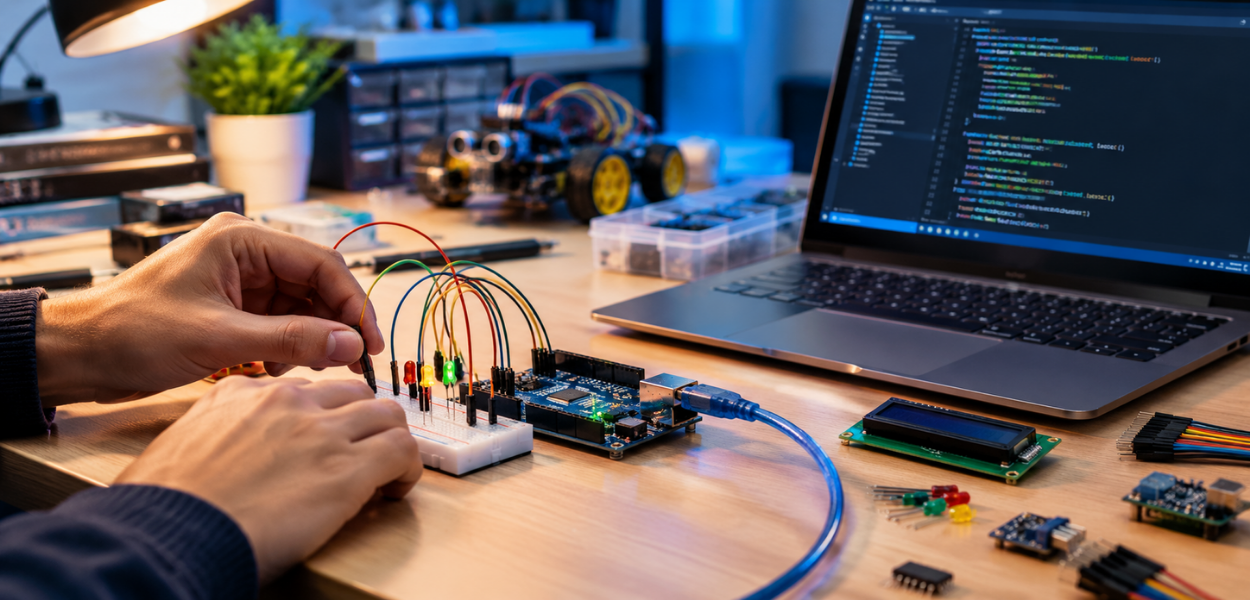
Embedded systems and microcontroller programming courses build engineers' practical ability to design, write, and test software that runs inside the devices themselves, the kind found in automotive systems, medical devices, and industrial automation. Their core purpose is to close the skills gap that slows down the product development cycle.
Embedded systems bring hardware and software together into a single unit that operates as one. The microcontroller is what executes the instructions that control the actual inputs and outputs, such as sensors, motors, and displays, and writing that software is what we call firmware development.
Companies that build connected products need engineers who understand circuit behavior and programming logic together. When this skill is missing, a real bottleneck appears: product launches slip, debugging cycles stretch out, and the QA team finds defects caused by weak firmware design rather than hardware failure.
Training courses address this gap directly, teaching engineers how to read component datasheets, configure registers, manage limited memory boundaries, and write code that runs reliably on resource-constrained hardware. The engineer moves from theoretical knowledge of programming to hands-on practice in embedded development, and the duration varies depending on the depth of content required.
For HR managers and learning and development officers, this course falls under technical upskilling programs and supports workforce transformation in engineering-heavy industries, because the integration between hardware and software is what determines how competitive a product is.
How do embedded systems courses work inside companies?
Training follows a clear sequence: skills assessment, curriculum design built around real hardware, hands-on lab sessions, project-based evaluation, and post-training performance follow-up. Every stage ties to an engineering competency that can be measured.
The process starts with a skills gap assessment, where managers identify which engineers lack competency in specific areas, such as configuring input/output ports or handling interrupts. This assessment prevents wasting time on general training in skills the engineer already has.
Curriculum design comes next, built around a specific family of microcontrollers, often ARM Cortex-M processors because they are the most widely used in embedded products across consumer electronics, automotive control units, and factory sensors. Trainers build lessons around register-level programming, peripheral configuration, and debugging with tools such as JTAG debuggers and oscilloscopes.
Delivery formats vary based on each company's needs; workshops suit teams that need intensive upskilling in a relatively short time, e-learning modules serve teams distributed across multiple sites, and blended learning combines theory modules the engineer completes independently with in-person lab sessions for hardware-dependent training.
Learning relies on real-world case studies rather than abstract theory, so engineers work through actual software bugs, timing conflicts, and memory overflow cases drawn from real production environments. Simulation also allows practice on virtual hardware before the engineer handles real boards, which reduces equipment costs and scheduling constraints.
Evaluation closes the loop; the engineer completes a functional project, such as building a sensor-based control system, and demonstrates competency against clear technical criteria. Companies that want a deeper technical track for their team then move on to specialized modules such as Embedded Systems and Microcontroller Programming: Interrupts, Timers and Peripheral Drivers, which covers real-time operating system concepts and peripheral driver development once the fundamentals are confirmed.
What are the core components of an embedded systems and microcontroller programming course?
A complete course covers microcontroller architecture fundamentals, interfacing with input/output ports and peripherals, interrupt handling, real-time operating system concepts, firmware development practices, and hardware debugging techniques. Each element builds on the one before it, leading up to production-ready software.
Architecture fundamentals cover memory organization, clock configuration, and instruction sets, and the engineer learns the difference between a processor such as the ARM Cortex-M4 and an 8-bit microcontroller in terms of processing speed, power consumption, and the number of available peripherals.
Input/output port configuration teaches the engineer how to control physical pins to read sensors and drive motors. This component is the foundation of any embedded application, from a simple light-control system to a multi-sensor industrial monitoring device.
Interrupt handling is a core technical component, teaching the engineer to write code that responds immediately to hardware events, such as a button press or a sensor crossing a threshold, without continuously polling the system. Poor interrupt design causes missed events and device malfunctions during production.
Real-time operating system training introduces task scheduling, priority management, and resource sharing across concurrent processes. This component matters greatly for products that need predictable timing, such as medical monitoring devices and automotive safety systems.
Peripheral interfacing covers protocols such as I2C, SPI, and UART, which let the microcontroller exchange data with sensors, displays, and external modules. Firmware development practices teach version control, code documentation, and testing methodologies suited to embedded environments, where updates require physical access to the device.
Companies that want a complete technical track place this content within a broader curriculum such as Information Technology and Programming Courses, which organizes foundational and advanced embedded topics into a single workforce development plan.
What value do companies gain from embedded systems courses?
Trained engineering teams measurably reduce product development time, lower the post-launch failure rate, and reduce dependence on outside contractors. As a result, the training investment pays back to the company in a relatively short time.
Shorter development time comes from engineers who write correct firmware the first time instead of repeating multiple rounds of debugging. A team proficient in interrupt handling and timer configuration avoids the common timing errors that delay product testing.
A lower failure rate directly affects QA workload, because firmware defects, such as race conditions and memory leaks, account for a large share of field failures in connected products. A trained engineer catches these issues while developing, not after deployment, which reduces costly recalls and warranty complaints.
Reduced reliance on contractors lowers operating costs, because a company that used to outsource firmware development to external consultants retains that capability in-house after investing in training. This also protects intellectual property, because proprietary firmware design stays within the company instead of being shared with outside parties.
Team efficiency improves once engineers share a common technical vocabulary; engineers who have completed the same training communicate faster during code reviews and joint projects, which reduces misunderstandings between the hardware and software teams, a common cause of delays in embedded product projects.
Employee retention also improves when engineers see a clear technical growth path. Companies that offer a structured progression from foundational microcontroller training to advanced real-time operating system modules retain their engineers longer, because skill stagnation is one of the leading causes of technical talent turnover.
Who uses embedded systems skills, and in which industries?
Embedded systems courses benefit product engineering teams, quality assurance, R&D, and technical support, across industries such as automotive, healthcare, manufacturing, and consumer electronics. Each sector applies these skills according to its own product needs.
Automotive manufacturers use embedded programming in engine control units, sensor networks, and driver assistance systems, and need precise timing control and real-time operating system knowledge because vehicle safety systems cannot tolerate any processing delay.
Medical device manufacturers apply this training to patient monitoring equipment, diagnostic devices, and implantable technologies, and the regulatory requirements in this sector demand strict firmware verification, making structured training necessary for compliance documentation.
Manufacturing and industrial automation teams use embedded skills in programmable logic controllers, robotic control systems, and factory sensor networks, and prioritize peripheral interfacing knowledge because an industrial environment has dozens of sensors and actuators operating simultaneously.
Consumer electronics companies apply this training to products such as wearable devices, smart home devices, and home appliances, and the time-to-market pressure in this sector makes firmware development efficiency a direct competitive factor.
Technical support and field service teams also benefit from embedded systems familiarity even without direct development responsibility, because understanding firmware behavior helps the support engineer diagnose hardware-software interaction issues without escalating every case to the development team, which reduces resolution time and support cost.
What are the most common problems that weaken embedded systems training programs?
Generic curricula, the absence of hands-on training on real hardware, the lack of post-training evaluation, and disconnection from actual product platforms are the leading reasons embedded systems training fails to deliver a measurable return on investment.
Generic curricula are the most common point of failure; a program that covers general programming concepts without focusing on a specific microcontroller family leaves the engineer unable to apply what they learned to the company's actual production line. Training must connect to the hardware the engineer actually uses daily.
The absence of hands-on training significantly reduces retention, because embedded programming is an inherently applied discipline. An engineer who studies code on slides only, without configuring real registers, programming actual boards, or debugging real timing issues, retains a much smaller portion of the material compared to lab-based training.
The lack of post-training evaluation prevents the company from measuring impact; without a defined project or a technical test at the end of the course, a manager cannot confirm whether the engineer gained real functional competency or simply attended the sessions. This gap makes calculating return on investment nearly impossible.
Disconnection from actual product platforms causes a skill-transfer problem, so an engineer trained on a generic development board finds it difficult to apply what they learned to the company's own hardware without additional on-the-job learning, which lengthens the time before the training investment shows real results.
Companies that address these four failure points, through platform-specific curricula, mandatory lab hours, project-based evaluation, and a direct link to actual production hardware, turn training spend into real engineering capability instead of a mere formal exercise.


