
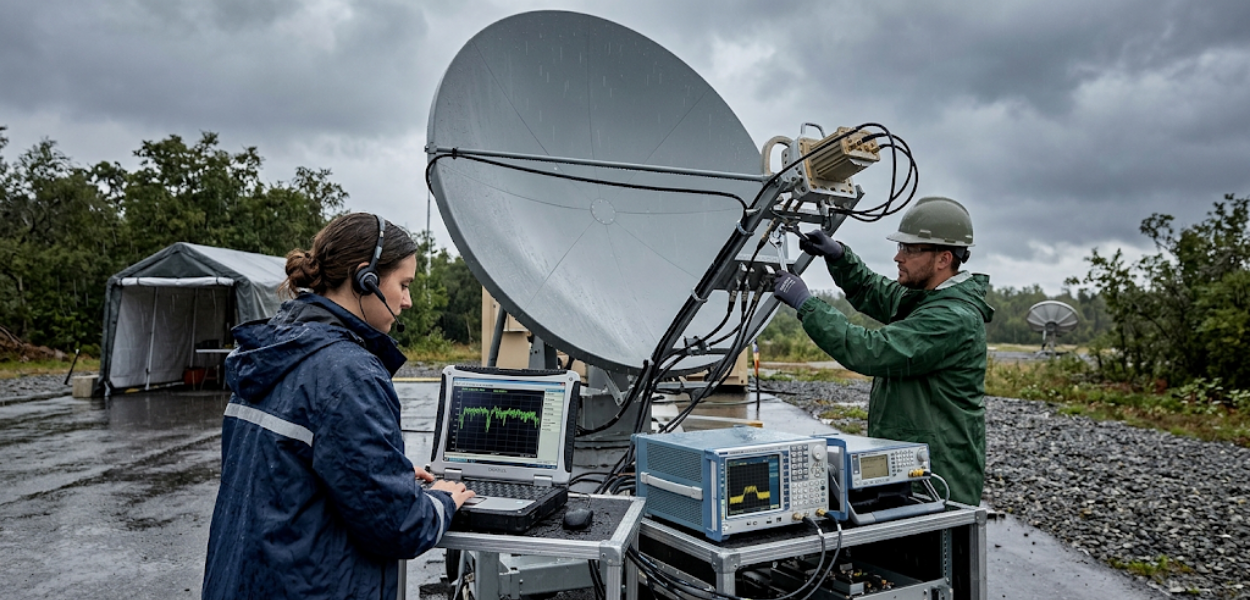
Satellite communication networks fail when a link budget calculation holds up on paper but is never actually tested against weather and equipment performance variance. Rain fade weakens signals in bands known for their sensitivity to atmospheric conditions during heavy rainfall. Link margin pressure increases when several variables, such as antenna gain, carrier power, and atmospheric loss, are underestimated at the design stage. An engineer whose experience is limited to the theoretical side faces a real challenge when an actual network degrades during a rainstorm, and stakeholders demand immediate answers that cannot wait.
This is the gap addressed in depth by Satellite Communication Systems and Ground Stations Training Courses, which provides the architectural foundation for ground segment operations before the engineer moves into link margin calculations under real-world pressure. This foundation is essential, because handling rain fade is not a single fixed equation; it is an integrated discipline built from orbital mechanics, carrier allocation, terminal specifications, and real-time monitoring, all applied together under time constraints that a classroom setting rarely replicates.
The course covered on this page is part of the Information Technology and Programming Courses category offered by the Arab British Fellowship Training Academy, and it is designed specifically for engineers and technical teams who need to design, monitor, and troubleshoot satellite links that must remain stable even as surrounding conditions deteriorate.
What Is the Course, and What Problem Does It Solve?
The course trains engineers and technical teams to calculate, monitor, and correct link budgets under rain fade and signal degradation conditions, closing the gap between theoretical knowledge of satellite communication systems and operational reliability in real network environments.
Satellite communication systems depend on a precise balance between transmit power, path loss, and receiver sensitivity, known as the link budget. As rainfall increases, atmospheric absorption rises, especially in the more sensitive frequency bands, and the margin built into the budget gets consumed quickly. Networks with insufficient margin suffer data loss, degraded broadcast quality, or a complete signal outage.
Organizations operating ground terminals, hub stations, and hybrid satellite-terrestrial networks face this problem repeatedly. Network operations teams often lack structured training in fade mitigation techniques, such as automatic uplink power control, adaptive coding and modulation, or site diversity, and the result is reactive fault handling instead of genuine engineered resilience from the start.
Why Is the Curriculum Designed in This Order?
The curriculum moves from orbital and carrier fundamentals, to link budget mathematics, to live fault diagnosis, because an engineer cannot address degradation without understanding the variables that built the original design margin in the first place.
Many technical courses separate theory from application, but this one does not. Each training module is built directly on the one before it, and each stage in the sequence corresponds to a stage of actual network operation. Participants first return to geostationary orbital mechanics and carrier allocation, because ground footprint coverage and frequency planning are what determine baseline signal strength before weather even enters the picture. This connects directly to the concepts covered in Satellite Communication Systems: Orbits, Transponders and Footprint Coverage Explained, which explains the relationship between orbital position and coverage area in detail. Understanding this relationship is what lets an engineer judge whether a fade event stems from a design flaw or a genuine environmental phenomenon.
After that, the course moves into building the link budget: uplink and downlink calculations, antenna gain, free space path loss, and system noise temperature. Rain fade modeling is not introduced until these fundamentals are solid, because fade margin calculation has no meaning without a correct baseline budget underneath it. This reflects a training philosophy the Arab British Fellowship Training Academy applies across its technical programs: skills are taught in the order they are used, not the order they appear in a textbook.
What Will Participants Learn?
Participants gain measurable competence in link budget calculation, rain fade mitigation, satellite tracking accuracy, and terminal tuning, verified through applied assessment rather than theoretical memorization alone.
The course is organized into four progressive skill modules:
- Orbital and carrier fundamentals: determining geostationary orbit position, carrier frequency allocation, ground footprint coverage maps, and understanding how a satellite's orbital position determines its exposure to specific weather conditions across different ground locations.
- Link budget engineering: uplink and downlink power calculations, antenna gain-to-noise-temperature ratios, and free space path loss modeling. Participants build link budgets from initial specifications rather than relying on ready-made templates.
- Rain fade and margin management: attenuation modeling in sensitive frequency bands, automatic uplink power control, adaptive coding and modulation, and site diversity planning, so participants can determine how much margin a given design retains at a specific rainfall intensity.
- Terminal tuning and tracking: small terminal alignment, satellite tracking systems, and diagnostic procedures for signal loss events, with training on diagnosing whether degradation stems from misalignment, equipment failure, or atmospheric interference.
By the end of the program, a participant can prepare a defensible link budget, identify fade risk before actual deployment, and correct a degraded link while the event is happening. These are the specific, testable outcomes that the Arab British Fellowship Training Academy builds its assessment structure around.
How Does the Course Progress?
The course progresses through a blended system: instructor-led technical workshops, online modules with simulation exercises, and optional on-site sessions for organizations training an entire network operations team.
Delivery is designed to suit individual engineers and organizational groups alike. The online modules cover theoretical and computational content: orbital mechanics, link budget mathematics, and rain fade modeling, and they are self-paced within a set course timeframe, which lets participants review calculation methods before tackling the assessments.
Instructor-led workshops focus on applied problem-solving. Participants work with instructors on link budget scenarios, including network outage cases where they must identify the root cause from limited data, which simulates the diagnostic pressure engineers actually face during fade events.
On-site delivery is available for organizations enrolling network operations teams or engineering groups as a group. The Arab British Fellowship Training Academy organizes on-site sessions around the organization's existing equipment specifications as needed, so the training reflects the network configurations participants actually manage. The full program runs across a set number of direct training hours, distributed across the course modules, with assessment checkpoints at each module transition rather than everything held back to the end.
How Are Participants Assessed?
Assessment combines computational tests, applied link budget assignments, and rain fade event simulation exercises, so competence is measured against realistic operational scenarios rather than multiple-choice questions.
Each module ends with a graded assessment component. The first and second module assessments require the participant to calculate orbital position and build a complete link budget from a given set of specifications, with no partial credit for merely recognizing the equation without applying it correctly. The third module assessment presents a rain fade simulation scenario with a specific rainfall rate and frequency band, and the participant must determine the remaining link margin and recommend a mitigation approach, whether adjusting adaptive coding, compensating uplink power, or switching to site diversity. The fourth module assessment is based on a terminal scenario reporting signal degradation, and the participant must diagnose the cause using the diagnostic sequence taught in the course.
What Outcomes Can Organizations Expect?
Organizations can expect a reduction in unplanned link outages, faster fault diagnosis during weather-related degradation, and engineers capable of designing fade-resilient link budgets without needing external consultants.
Network operations teams often report two recurring problems before training: over-designed link margins that waste power budget and cost, or under-designed margins that fail during moderate rainfall. Both problems share the same root cause, building link budgets from ready-made templates rather than first principles. After completing the program, engineers can build link budgets tailored to specific geographic regions based on rainfall rate, rather than applying a generic safety margin across every deployment, which reduces both unnecessary equipment cost and unplanned outage risk at the same time.
For HR teams and technical managers, the value extends beyond individual skill acquisition. Teams that complete the training together develop a shared diagnostic vocabulary, which shortens fault response time when an actual network degrades. The manager responsible for the satellite communications department can use the standardized assessment results issued by the Arab British Fellowship Training Academy to identify skills gaps across the team and plan further technical development based on evidence rather than assumptions. Organizations building or expanding small terminal networks, hub station operations, or hybrid ground infrastructure gain a workforce capable of verifying design decisions internally, which reduces reliance on external engineering consultants for routine link budget review.
How Do You Enroll in the Course?
Enrollment requires a basic understanding of radio frequency communication principles, passing a brief technical eligibility check, and registering through the Information Technology and Programming Courses track offered by the Arab British Fellowship Training Academy.
The course is classified at an intermediate-to-advanced technical level, and participants should have prior knowledge of radio frequency principles or basic satellite communications concepts, whether from prior study, professional experience, or completion of the introductory content referenced above. Applicants submit their professional background and technical exposure through the enrollment form, after which eligibility is confirmed against the course's technical entry requirements. Organizations enrolling several team members can arrange group registration, which allows on-site delivery to be scheduled around the team's operational calendar.
You may also want to read: Advance Your Radar Systems and Signal Processing Expertise with Engineers Who Have Built Them.
Engineers responsible for satellite link reliability, and the organizations that depend on their judgment during an actual fade event, benefit most from formal structured training rather than relying on assumptions accumulated on the job. To begin the enrollment and eligibility verification process, submit your application for the course here.


