Comparing SDR Platforms: RTL-SDR, HackRF, and USRP for Real Projects
Choosing a software-defined radio (SDR) platform determines what an engineering team can actually build, test, and deploy. RTL-SDR, HackRF, and USRP platforms span different tiers of price, frequency range, and processing power, and each one suits a different stage of development — from initial signal exploration all the way to deploying a full transceiver in commercial or defense systems.
What Sets These Three Platforms Apart?
RTL-SDR is a receive-only device priced under £30, HackRF is a half-duplex transceiver priced at around £300, and USRP is a full transceiver platform built around a field-programmable chip, starting at over £1,200. These three tiers represent an entry-level monitoring tier, a mid-range prototyping tier, and an advanced production-deployment tier — and each tier trades price against bandwidth, dynamic range, and real-time processing headroom.
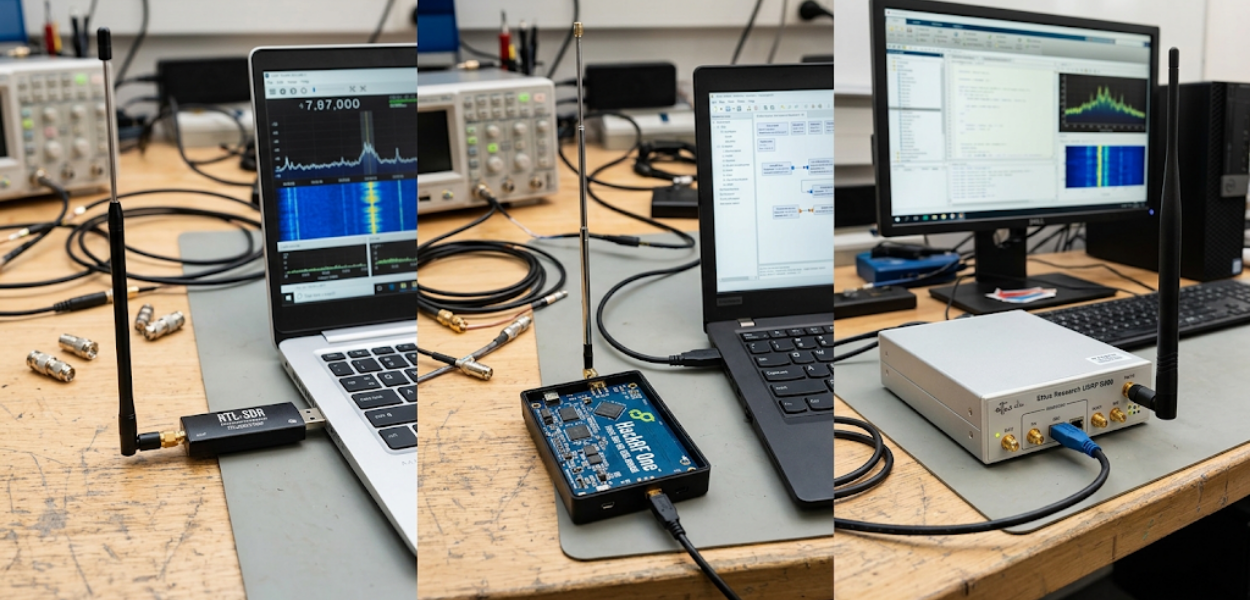
RTL-SDR originated from repurposed digital TV tuner chips, and it covers a range from 500 kHz to 1.7 GHz, with an 8-bit ADC and a maximum sample rate of around 3.2 million samples per second. The device cannot transmit, and engineers use it for spectrum monitoring, aircraft tracking, and reviewing basic protocols.
HackRF extends coverage from 1 MHz to 6 GHz, with a sample rate of up to 20 million samples per second. It transmits and receives, but not at the same time, which limits its use for full-duplex link testing — it suits protocol reverse engineering and generating test signals to check receivers.
USRP, on the other hand, uses daughterboards to extend frequency coverage from under 1 MHz to over 6 GHz depending on configuration, and the sample rate on advanced models reaches hundreds of millions of samples per second. Its field-programmable front end handles real-time processing that would otherwise overload a general-purpose processor, which makes it the go-to choice for cellular network research, radar development, and multi-channel system experiments.
How Do Downconversion and Sample Rate Differ Across Platforms?
Downconversion capability scales directly with hardware cost: RTL-SDR relies on the host computer's processing, HackRF splits the load between hardware and software, while USRP performs this conversion on-device through its field-programmable front end before the data ever reaches the host computer. This difference determines how much instantaneous bandwidth each platform can sustain without dropping samples.
RTL-SDR streams raw I/Q data to the host computer over a USB 2.0 port, leaving all conversion and filtering to software on the connected computer — this works fine for narrowband signals under 3 MHz, but it causes latency and dropped samples when monitoring wider spectrum slices. HackRF improves on this with a wider port and internal filtering stages, but conversion still depends heavily on the host system's processing power. USRP, meanwhile, performs conversion, decimation, and filtering directly inside the field-programmable front end before transferring data, and models that use USB 3.0 or fast Ethernet sustain sample rates that are simply unreachable on devices constrained by an older port.
What Practical Applications Suit Each Platform?
RTL-SDR suits hobbyist spectrum monitoring, aircraft tracking, and educational signal analysis — it shows up often in university labs, since its low cost allows dozens of units to be deployed in a single classroom or across a distributed sensor network. HackRF suits penetration testers and security researchers examining wireless protocols such as garage-door openers and tire-pressure monitoring systems, and its ability to transmit lets engineers generate test signals to validate receivers — a task RTL-SDR simply cannot perform.
USRP dominates commercial and defense research, where signal fidelity, timing precision, and multi-channel synchronization determine whether a project succeeds. Telecom companies use it to model 5G waveforms before committing to a custom chip. Once an organization reaches this level of technical maturity, the decision shifts from simply picking hardware to building in-house capability that can support SDR projects over the long term.
What Software Ecosystem Supports Each Platform?
GNU Radio is the dominant open-source framework across all three platforms, supported by software such as SDR# and CubicSDR for RTL-SDR, while USRP relies on its own dedicated driver (UHD). Software compatibility often matters more than raw hardware specs when a team is choosing a platform for a project on a fixed timeline.
GNU Radio Companion lets engineers build signal-processing flowgraphs visually, chaining together filtering, demodulation, and decoding blocks without writing low-level code for every function. RTL-SDR users typically pair the device with SDR# or CubicSDR for simple tasks, while USRP needs a far more involved setup — understanding clock references, timed commands, and multi-device synchronization before deploying multi-channel systems.
What Selection Criteria Should Engineering Teams Apply?
Teams need to assess frequency-range requirements, the required sample rate, full-duplex needs, per-unit budget, and the team's familiarity with the available software before committing to a specific platform. Skipping this assessment leads to a mismatch between the hardware and the actual need — either underperforming against project requirements, or wasting capital on capability that will never get used.
Frequency-range requirements come first — a project monitoring only the 2-meter amateur band doesn't need multi-gigahertz USRP coverage. Sample-rate requirements come right after that — narrowband signals like audio or telemetry sit comfortably within RTL-SDR's ceiling, but wideband signals like modern cellular waveforms need USRP-level processing. And full-duplex requirements clearly separate HackRF from USRP — any application that needs simultaneous transmit and receive rules out HackRF's half-duplex architecture entirely.
How Does Platform Complexity Affect Workforce Skill Gaps?
Platform complexity is directly tied to the level of engineering skill required: RTL-SDR needs basic familiarity with digital signal processing, HackRF needs intermediate knowledge of RF and protocols, and USRP needs advanced expertise in field-programmable interfaces, RF engineering, and real-time systems. Organizations that misjudge the match between platform complexity and team capability end up logging project delays that exceed 40% of the original schedule.
Skill gaps surface faster when organizations acquire USRP hardware without a matching investment in field-programmable interface programming training. Engineers used to purely software-based development environments need structured upskilling before they can edit UHD drivers or manage clock synchronization. HR teams evaluating training budgets need to treat SDR platform adoption as a workforce-planning decision, not just a procurement decision.
Cohort-based technical training with hands-on hardware work produces faster, more measurable progress than self-paced video courses alone, especially for skills tied to field-programmable interfaces and RF, where hands-on familiarity with real hardware cannot be replaced by theory alone.
Conclusion
Matching the platform to the actual application prevents both under-provisioning and unnecessary capital spending. Engineering teams that invest in understanding the technical differences between these three platforms — and pair that investment with training matched to the level of complexity — are the ones able to reduce the risk of schedule overruns and build consistent technical competence across the whole team.