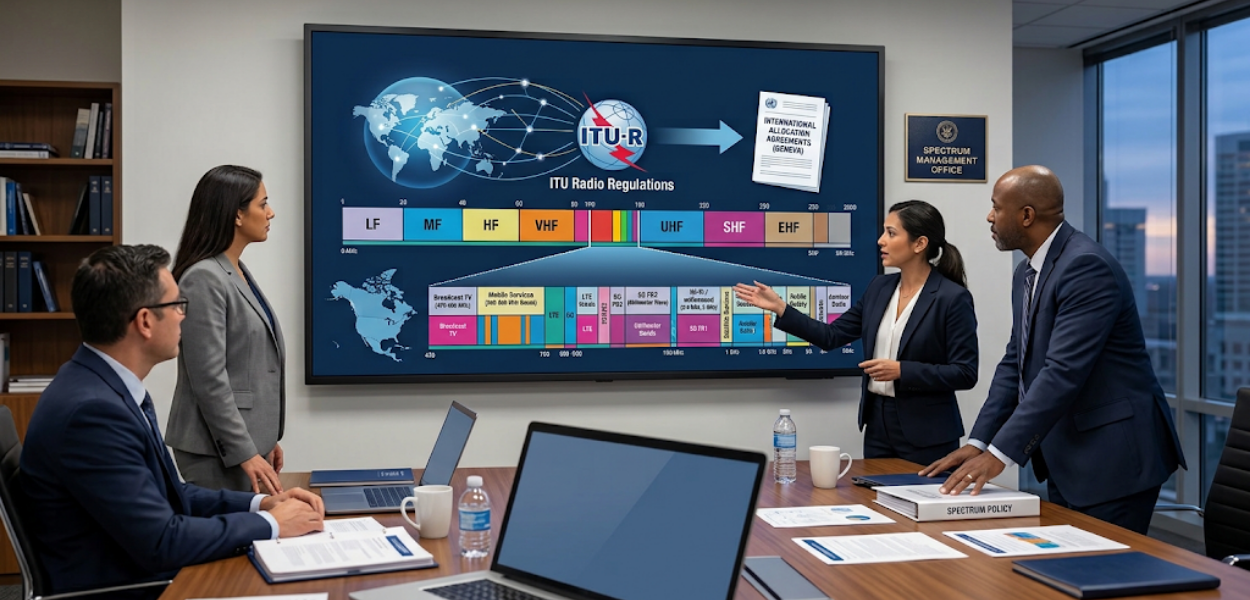
ITU Radio Regulations and National Frequency Allocation
Radio frequencies know no borders. A broadcast signal transmitted in one country can weaken a mobile network in a neighboring country if no one coordinates who transmits and from where. Spectrum management exists precisely to prevent this outcome, and it operates on two levels at once: an international rulebook overseen by the International Telecommunication Union, and a national table that every country builds based on that rulebook.
For engineers, regulators, and telecom operators building this capability from the ground up, the starting point is usually foundational: understanding how monitoring stations detect unauthorized transmissions, how frequency bands are organized, and how allocation differs from assignment. New teams in this specialty typically build this foundation through Spectrum Management and Radio Monitoring Training Courses, which covers the technical terminology and monitoring methods referenced in this article. Once that foundation is solid, the harder question becomes operational: how a national administration turns an international table into an enforceable local licensing system.
What Is Spectrum Management, and Why Does It Need International Coordination?
Spectrum management is the process of allocating, assigning, and monitoring radio frequencies to prevent interference between services, and it needs international coordination because radio waves cross borders regardless of national boundaries.
The radio spectrum extends from very low to very high frequencies, and each band within that range carries a limited capacity for a number of simultaneous users who do not interfere with one another. When two transmitters operate on the same frequency within overlapping coverage areas, each one's signal degrades because of the other. And because high and very high frequency signals propagate over long distances, extending hundreds or thousands of kilometers, no country can manage its spectrum in isolation. The International Telecommunication Union, a specialized agency of the United Nations, issues a single international reference specifically to prevent this conflict: a frequency allocation table published within its Radio Regulations. Every member state of the Union uses this table as the basis for its national frequency planning, which keeps cross-border interference within manageable limits and lets equipment manufacturers design radios that work across multiple markets.
What Do the ITU Radio Regulations Actually Govern?
The ITU Radio Regulations are a binding international treaty that defines which services are permitted to use each frequency band, under what conditions, and in which region of the world, and they are updated every few years.
These regulations cover a large number of radio communication services, including fixed services, mobile services, radio and television broadcasting, satellite systems, radio navigation services, and radio astronomy services. Their first article defines the terms used throughout the treaty: allocation is an entry in the table permitting a given service to use a given band, assignment is the authorization granted to a specific station to operate on a specific frequency, and allotment falls between the two, reserving a frequency or channel for use by one or more administrations within a defined geographic area.
This distinction has operational consequences; a government does not assign spectrum directly from the international table, but it first confirms that the band is allocated to the relevant service, then issues assignments through its own licensing procedures. World Radiocommunication Conferences review these regulations periodically, and the most recent conferences have focused on millimeter-wave bands for fifth-generation network deployment, and sharing the 6 GHz band between local wireless connectivity and mobile broadband networks, which illustrates how the treaty adapts to new technology requirements without abandoning its original structure.
How Does Article 5 Organize the International Frequency Allocation Table?
Article 5 lists every frequency band against the radio communication services permitted to use it, distinguishing between primary and secondary services, and separating entries by region where global agreement is not possible.
Services within Article 5 are classified as primary or secondary. A primary service has priority, can claim protection from harmful interference, and is not obligated to accept interference from other services sharing the same band. A secondary service, on the other hand, must not cause interference to a primary service, and has no right to claim protection against one. Some bands carry exclusive allocations reserved for a single service worldwide, while others carry shared allocations that allow several services to coexist within the same band under specific technical conditions. Footnotes attached to particular entries add further restrictions, limiting use to specific countries, specific technical standards, or specific time periods. National regulators copy their region's column from Article 5 as a starting point for local frequency tables, then add national footnotes reflecting their local priorities.
Why Do Allocations Differ Between ITU Regions?
The ITU divides the world into three regions for spectrum planning, because setting a single global allocation for every band is not practical. Region 1 covers Europe, Africa, the Middle East, and the former Soviet Union; Region 2 covers the Americas; and Region 3 covers Asia and the Pacific.
A band allocated to a given service in one region can carry an entirely different allocation in another. An example is the 902-928 MHz band; in Region 2, this band is allocated to industrial, scientific, and medical uses, and carries unlicensed devices such as LoRa-based sensors. In Region 1, however, the same band is used for railway mobile communications and is not available for unlicensed devices. You cannot assume that a device approved in one region will work in another. This regional division reflects historical spectrum use, existing infrastructure investment, and national priorities that could not be reconciled within a single global table without disrupting services already established in each region. Regulators and network planners working across regions treat this variation as a permanent constraint on equipment procurement and roaming service design.
How Does the National Frequency Table Relate to the ITU Table?
The national table takes the relevant region's column from Article 5 as its base, then adds national footnotes, service priorities, and licensing categories that reflect the country's own infrastructure and policy goals.
For example, Uganda's national table copies Region 1 entries from Article 5 into a single column, then lists Uganda-specific allocations and notes in adjacent columns. Nigeria, also located within Region 1, built the latest major update to its table on a national spectrum audit combined with the outcomes of that year's World Radiocommunication Conference. Jordan's table follows the same pattern, copying Region 1 entries and footnotes before adding national conditions. This pattern repeats across the ITU's member states: copy the regional allocation, then localize it. National administrations review this table periodically, particularly after each World Radiocommunication Conference, to keep domestic policy aligned with the updated international treaty, while accommodating services such as fifth-generation networks, satellite broadband, and the Internet of Things, which earlier allocations did not account for.
What Role Does Spectrum Monitoring Play in Enforcing Frequency Allocations?
Spectrum monitoring verifies that transmitters operate within their assigned frequency, bandwidth, and power limits, using frequency measurement, occupancy measurement, and direction finding to detect unauthorized use and locate sources of interference.
A national frequency table has no enforcement value without a monitoring capability to support it. Monitoring stations perform a set of core measurement tasks defined in ITU recommendations: frequency measurement, field strength and power flux density measurement, bandwidth measurement, modulation measurement, spectrum occupancy measurement, and direction finding. Occupancy measurement records emissions across a frequency channel over a defined time period, producing usage statistics that show whether a band is congested enough to justify reallocation or additional licensing. Direction finding identifies the actual source of a signal by comparing its angle of arrival at multiple receiving points, the technique used when tracking an unlicensed transmitter or a device causing harmful interference to a licensed service. Interference tracking combines both; occupancy data confirms a problem exists on a given frequency, and direction finding pinpoints its physical location. The ITU's spectrum monitoring handbook sets performance standards for this equipment, including antenna accuracy and receiver sensitivity, so that monitoring stations across different countries produce comparable, defensible results.
Where Does Licensing Fit in the Path From Allocation to Assignment?
Licensing is the administrative step that converts an entry in the national table into a specific operator's legal right to transmit on a specific frequency, and it depends on accurate monitoring data to remain enforceable.
Once a band is allocated to a given service within the national table, the regulator can issue assignments within that band to individual applicants. The license specifies the frequency, bandwidth, power limit, geographic coverage, and license duration. Issuing a license without verifying existing occupancy in that band risks allowing interference between two licensees, which undermines the entire allocation structure everything else depends on. Regulators increasingly use automated spectrum management systems that combine the national table, licensing records, and live monitoring data within a single platform, flagging conflicts before a license is issued rather than only after interference is reported. Building and maintaining these systems requires staff who understand both the regulatory framework and the software layer running the databases and monitoring interfaces behind it, a combination typically gained through Information Technology and Programming Courses alongside the regulatory training itself.
You may also want to read: Satellite Communication Systems: Orbits, Transponders and Footprint Coverage Explained, or Radar Systems: Range Resolution, Doppler Shift and Radar Cross Section Explained.
What Capability Gap Prevents Organizations From Managing Spectrum Compliance Effectively?
Most organizations understand the concept of frequency allocation, but they lack staff who can apply Article 5, interpret national footnotes, and operate monitoring equipment to the standard regulators expect, a structured capability gap, not a knowledge gap.
Telecom operators, broadcasters, and government agencies usually employ engineers who understand radio wave propagation and equipment tuning. But far fewer of them can read a national frequency table alongside its regulatory footnotes, correctly classify a given service as primary or secondary, and defend a licensing decision in front of a domestic or regional audit. This differs from skills gaps in adjacent fields, where a single self-paced module closes the gap. Because spectrum regulation requires hands-on, guided practice on monitoring equipment and applied reading of live national footnotes, direct lab-based training outweighs self-paced formats.
This gap shows up during spectrum audits, cross-border interference disputes, and preparation cycles for World Radiocommunication Conferences, when an administration needs staff able to represent its position with the same regulatory fluency as the international delegates they are negotiating with. HR and learning and development teams tasked with this training typically measure return through audit outcomes and licensing accuracy, not through course completion rates: fewer licensing conflicts, faster conference preparation cycles, and reduced reliance on external consultants during interference disputes. Closing this gap requires training built on the same regulatory knowledge that regulators themselves apply daily, not generic radio engineering content. Organizations addressing this issue directly typically move through a program such as Take Charge of Spectrum Management with Regulatory Knowledge Regulators Themselves Expect, built around applying Article 5, interpreting the national table, and monitoring operations, rather than general communications theory.