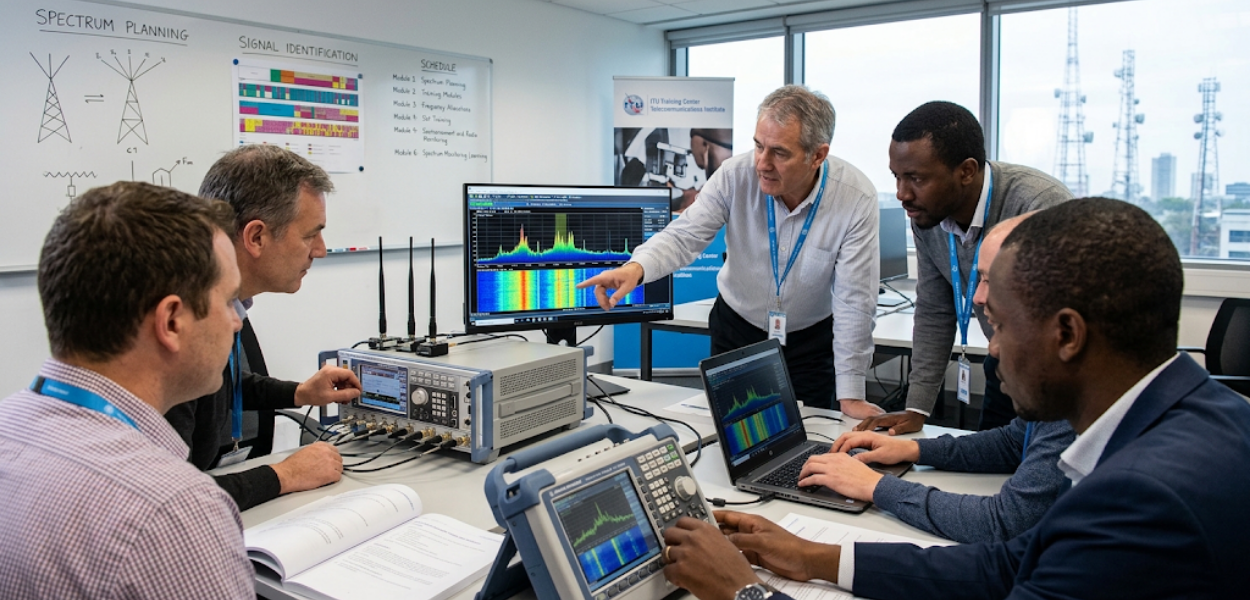
Spectrum Management and Radio Monitoring Training
What Is Spectrum Management and Radio Monitoring?
Spectrum management is the structured control of radio frequency use within an organization, covering frequency allocation, licensing, interference tracking, and direction finding. Radio monitoring courses qualify staff to measure spectrum occupancy, detect unlicensed transmissions, and maintain regulatory compliance in the telecommunications, defense, aviation, and broadcasting sectors.
Radio frequency is a finite resource. Every transmitter, from a base station to a mobile network to a maritime radio, operates within a licensed frequency band. Spectrum management courses teach staff how to allocate, monitor, and protect these bands from interference.
This specialty sits at the intersection of engineering, regulation, and operations. Engineers need it to design interference-free systems. Compliance teams need it to avoid licensing violations. Operations managers need it to maintain the continuity of critical communications during equipment failures or signal congestion. And organizations operating in regulated sectors, such as telecommunications, aviation, maritime transport, and defense, depend heavily on accurate spectrum use, because a single unauthorized transmission can disrupt air traffic control, emergency services, or broadcast signals. Training reduces these risks by building internal capability instead of relying entirely on outside consultants.
The Information Technology and Programming Courses category places spectrum management within a broader technical skills framework, connecting radio frequency management to network infrastructure, systems engineering, and the technical compliance functions organizations already operate.
How Do Spectrum Management Courses Work Inside Organizations?
The training follows a structured process: a skills gap assessment, technical instruction on frequency allocation and monitoring tools, hands-on direction-finding exercises, and a post-training competency assessment. Delivery combines classroom instruction, simulation labs, and field exercises over programs that typically run for several working days.
The process starts with a skills audit. Organizations identify the staff who work with spectrum-related systems: network engineers, compliance officers, field technicians, and regulatory affairs staff. This audit determines training depth, from basic awareness to advanced certification in interference tracking.
Instruction covers three layers:
- Regulatory layer: national frequency tables, licensing procedures, and international coordination requirements set by the bodies responsible for radio communications worldwide.
- Technical layer: spectrum analyzers, direction-finding equipment, and occupancy measurement software.
- Operational layer: incident response when interference disrupts a live operational system.
Delivery formats vary according to organizational need. Workshops suit compliance staff and managers who need conceptual understanding. Hands-on lab sessions suit engineers who directly operate monitoring equipment. Blended programs combine online theoretical modules with in-person field exercises, which reduces time away from operational duties compared with fully in-person formats.
Implementation typically moves from general awareness to specialization. Organizations often start with a foundational training group, then select staff for advanced certification in direction finding and interference tracking based on their operational role. A reader evaluating training providers at this stage benefits from a deeper technical breakdown, covered in Spectrum Management: ITU Radio Regulations and National Frequency Allocation Explained, which clarifies how frequency allocation and licensing rules are applied at the national level.
Assessment concludes the process. Competency tests, hands-on exercises, and simulated interference scenarios confirm whether staff can apply the training independently, not just meet attendance requirements.
What Are the Core Components of Spectrum Management Programs?
The core components include frequency allocation principles, licensing procedures, direction-finding methodology, occupancy measurement techniques, and interference tracking protocols. Programs also cover regulatory frameworks, monitoring equipment operation, and the incident documentation standards required for compliance reports.
- Frequency allocation and licensing: trainees learn how national regulators assign frequency bands to services such as broadcasting, aviation, maritime transport, and mobile communications. Licensing modules cover application procedures, renewal deadlines, and the penalties for unlicensed transmission.
- Direction finding: identifies the actual source of a radio signal. Staff train in triangulation techniques using fixed and mobile monitoring stations, a core skill for locating unauthorized transmitters or diagnosing sources of interference in sectors such as broadcasting, telecommunications, and defense.
- Occupancy measurement: determines how intensively a given frequency band is used over a specific time period. Training covers reading spectrum analyzer output, interpreting occupancy rates, and identifying underused bands available for reallocation.
- Interference tracking: combines direction finding and occupancy analysis to resolve actual disruptions. Staff practice scenario-based exercises simulating equipment failure, illegal broadcasting, or cross-border signal leakage.
- Delivery formats: programs typically combine classroom instruction in regulatory theory, simulation labs for equipment operation, field exercises for direction finding, and case-based assessments for interference response, and organizations choose the format based on the employee's role and the time available for training.
What Benefits Do These Courses Deliver for Organizations?
Trained organizations record fewer licensing violations, faster interference resolution, and less reliance on external consultants. Observable results include a marked reduction in compliance incidents, faster fault resolution, and a clear improvement in internal capability across engineering and compliance teams.
Compliance risk decreases when staff understand licensing requirements directly. Organizations that used to rely on external audits to catch violations now identify and correct these issues internally, before regulators get involved. Operational continuity improves, because interference disrupts communication systems in sectors such as aviation, maritime transport, and emergency services, where downtime carries safety consequences, not just financial cost. Trained teams resolve these incidents faster because they recognize interference patterns without escalating every incident to outside specialists.
Cost efficiency results from reduced reliance on consultants, since organizations that train their own staff in direction finding and occupancy measurement reduce recurring consulting spend, as routine monitoring and first-response interference handling move in-house. Cross-departmental capability also improves, because compliance staff gain the technical familiarity to interpret engineering reports accurately, and engineers gain the regulatory familiarity to design systems within licensing constraints. This shared understanding across functions reduces miscommunication between technical and compliance teams during audits or incident reviews. Retention in technical roles also improves, since employees in specialized fields like radio frequency engineering value structured career progression, and organizations offering recognized spectrum management training see lower turnover in these roles.
Who Uses Spectrum Management Skills?
Core users include telecommunications network teams, aviation and maritime regulatory staff, defense signals units, broadcast engineers, and technical compliance departments. The sectors with the highest demand are telecommunications, aviation, maritime transport, defense, and public safety communications.
Telecommunications teams use spectrum management daily, and network engineers coordinate frequency use across mobile base stations, avoiding interference between operators sharing adjacent bands. Aviation and maritime organizations depend on interference-free communications for safety-critical operations, and air traffic control and vessel tracking systems require continuous spectrum monitoring, which makes direction-finding competence a regulatory expectation rather than an optional skill. Defense and public safety units apply interference tracking to secure tactical and emergency communications, and signals teams identify jamming, unlicensed transmissions, or equipment failures that weaken operational security.
Broadcast engineers manage occupancy measurement to protect licensed frequencies from encroachment, and radio and television broadcasters monitor adjacent bands to prevent transmission quality degradation. IT and compliance departments increasingly intersect with spectrum management as organizations expand their deployment of private wireless networks, connected devices, and indoor wireless systems, and compliance staff need practical knowledge of licensing obligations even outside heavily wireless-dependent sectors.
What Common Problems Undermine Spectrum Management Programs?
Common failures include generic training unrelated to the organization's equipment, the absence of measurable competency assessment, and one-off sessions with no refresher courses. These gaps produce compliance risk, poor return on investment, and staff unable to apply their skills during actual interference incidents.
Generic programs fail because spectrum management depends heavily on each organization's specific equipment and regulatory context, and a course built on a single country's licensing framework does not transfer directly to another country's frequency tables. The absence of assessment produces a false sense of readiness, because attendance certificates confirm participation, not competence, and organizations relying solely on attendance records discover the gap when staff cannot operate monitoring equipment during an actual incident.
One-off training also loses value quickly, because spectrum regulations change as national regulators reallocate bands for new services such as fifth-generation network expansion, and without refresher training, staff knowledge becomes outdated within a relatively short time. Weak return on investment often stems from an unbalanced training scope, and programs that cover broad theory without hands-on direction-finding practice leave staff unable to apply the concepts operationally. Organizations measuring training success should track incident response time and compliance audit outcomes, not completion rates alone.
Fragmented ownership is an additional problem. When spectrum management training responsibility falls on IT alone, compliance risk gets overlooked. When it falls on compliance alone, technical application weakens. Effective programs involve both functions together from the design stage.
You may also want to read: Satellite Communication Systems and Ground Stations: Training Courses, or Radar Systems and Signal Processing Training Courses.