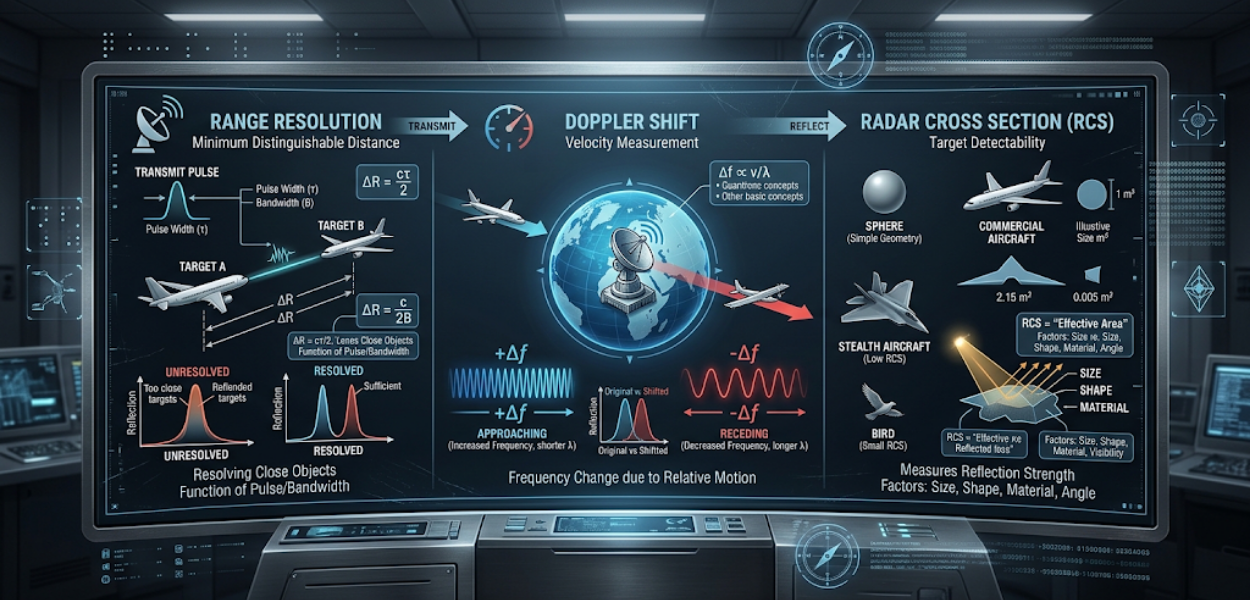
Radar Systems: Range Resolution, Doppler Shift, and RCS Explained
Radar performance depends on how accurately a system can detect objects, separate targets from one another, determine motion, and maintain reliable measurements in complex environments. Range resolution, Doppler shift, and radar cross section are three fundamental concepts that determine how radar signals behave, and how effective systems are at interpreting reflected energy.
Understanding these concepts provides the technical foundation for evaluating radar systems and signal processing approaches, especially when organizations need engineers and technical teams to improve detection performance, signal interpretation, and operational reliability. For a broader perspective on radar capabilities, signal-processing approaches, and professional development, see radar systems and signal processing training courses.
What Determines Range Resolution in Radar?
Range resolution determines how close two objects can be along the radar's line of sight while still being detected as two separate targets, and bandwidth, pulse duration, waveform design, and signal processing all directly control the level of separation achievable.
Range resolution is fundamentally tied to the transmitted radar signal's bandwidth. In basic pulsed radar, range resolution is determined approximately by the relationship between pulse duration and the propagation speed of electromagnetic energy. Shorter pulses provide higher resolution because the reflected signals occupy a smaller time interval.
For a radar signal with effective bandwidth B, range resolution is calculated approximately using the relationship: ΔR ≈ c / 2B, where c is the speed of light and B is the signal's bandwidth.
As an illustrative example: a bandwidth of 10 megahertz gives a theoretical range resolution of about 15 meters, while a bandwidth of 100 megahertz gives a resolution of about 1.5 meters under ideal conditions. This difference matters when radar operators need to distinguish between vehicles, aircraft, maritime objects, or other targets located close to each other.
Pulse duration also affects basic radar resolution. A longer transmitted pulse carries more energy and supports detection in difficult conditions, but its duration imposes a larger minimum distance required to separate two targets. This creates an engineering trade-off between transmit energy and resolution.
Modern systems address this trade-off through waveform design and signal processing. Pulse compression lets radar transmit a long, coded or frequency-modulated pulse while processing the received signal to achieve a much narrower effective response. This technique decouples transmit-energy requirements from final range resolution, which is why engineers evaluate waveform bandwidth and processing performance together, rather than relying on pulse duration alone.
How Does Pulse Compression Improve Radar Performance?
Pulse compression improves radar performance by transmitting energy through a relatively long waveform, then using signal processing to produce a compressed, narrow response, which improves range resolution without imposing the same constraints a very short pulse would.
Pulse compression is especially important in systems that need both detection range and the ability to separate targets from each other. A long pulse transmits more energy toward the target, increasing the energy available for detection, and processing then compresses the received waveform to produce a narrower response.
Linear frequency modulation is one of the most well-known pulse-compression techniques, in which the transmitted signal's frequency changes across the pulse's bandwidth. When the received signal passes through the appropriate processing stage, the frequency components align and produce a concentrated peak at the output.
The compression ratio is tied to the product of pulse duration and bandwidth, and increasing that product generally increases the processing gain available from pulse compression.
The matched filter is a core element of this process, designed to maximize the signal-to-noise ratio for a known transmitted waveform. In radar processing, the matched filter matches the received signal against the expected waveform and produces a strong response when the waveform is present, which leads to a clearer detection peak that supports improved range estimation.
For organizations managing specialized radar engineering teams, pulse compression is not just a transmission technique, but requires an integrated understanding of waveform generation, receiver architecture, digital signal processing, sampling, filtering, and detection algorithms. Training decisions must reflect this system-level relationship, because an engineer who only understands individual processing stages in isolation will have a weaker grasp of how changes in bandwidth, sampling rate, filter design, and waveform selection affect overall radar performance.
What Is Doppler Shift, and Why Does It Matter in Radar?
Doppler shift is the change in frequency caused by relative motion between the radar and the target, and it lets radar systems estimate radial velocity and distinguish moving objects from stationary reflections and background noise.
When a radar transmits a signal toward a moving target, the frequency of the reflected signal differs from the transmitted frequency, and this difference is called the Doppler shift.
In monostatic radar systems, where the transmitter and receiver are at the same location, the Doppler frequency is typically calculated from the relationship: f_D = 2v / λ, where v is the target's radial velocity and λ is the radar's wavelength. The factor of two exists because the radar signal travels from the transmitter to the target and back again to the receiver.
A target moving toward the radar produces a different frequency response than one moving away from it, so the measured Doppler frequency provides information about radial motion.
Doppler processing becomes especially important when radar systems operate in environments containing stationary objects, terrain, buildings, vegetation, or other sources of unwanted reflections.
A radar system can analyze frequency changes across several received pulses to identify moving targets, and this process typically involves coherent processing, pulse-to-pulse comparison, Doppler filtering, and detection algorithms.
Doppler information also adds design considerations; the pulse repetition frequency affects the unambiguous velocity range, and coherent processing intervals affect Doppler resolution. This creates a link between radar waveform design and signal-processing architecture, which is why engineers evaluating system performance need to consider range and velocity measurements together, not as fully independent parameters.
How Does Doppler Processing Support Clutter Rejection?
Doppler processing supports clutter rejection by separating radar reflections according to frequency or velocity characteristics, letting processing systems suppress stationary or slowly changing reflections while retaining information associated with moving targets.
Clutter refers to unwanted radar reflections that do not represent the target of interest. Ground surfaces, buildings, vegetation, weather phenomena, and sea conditions produce different forms of clutter depending on the radar's environment, which is why clutter rejection is a core part of radar signal processing.
Moving target indicator and moving target detection techniques use differences between successive radar reflections to identify motion, and Doppler filters separate signals by frequency, providing a mechanism for reducing reflections that fall within unwanted velocity ranges.
Clutter-rejection effectiveness depends on the environment and the radar's architecture. A reflection from stationary ground has entirely different Doppler characteristics than a fast-moving aircraft, but wind-blown vegetation, rotating machinery, waves, and weather phenomena produce more complex Doppler behavior, so engineers need to evaluate clutter characteristics alongside target characteristics.
Weak clutter rejection increases false detections and reduces the ability of operators or automated systems to identify important targets, while excessive filtering, in turn, suppresses genuine targets. A balanced processing strategy therefore requires knowledge of the expected operating environment, target speed distribution, radar waveform, antenna characteristics, receiver performance, and detection limits.
For organizational training decisions, these relationships matter because radar engineers often work across several technical disciplines, and effective development programs need to connect theoretical signal processing to practical, system-level performance analysis.
What Is Radar Cross Section, and How Does It Affect Detection?
Radar cross section describes how much electromagnetic energy an object reflects back toward the radar, and target shape, material, wavelength, viewing angle, and surface characteristics all affect the strength of the reflected signal.
Radar cross section is typically expressed in square meters, and it does not simply represent an object's physical size. A relatively large object can produce a smaller radar reflection from a given viewing angle, while a smaller structure with effective reflective geometry can produce a stronger reflection.
Several characteristics affect radar cross section, such as an object's shape, electrical properties, surface structure, the radar's wavelength, polarization, and the angle relative to the radar. Viewing angle is particularly important, because an object can present different reflective characteristics as its orientation relative to the radar changes.
Radar cross section also affects detection range, because the strength of the reflected signal affects the signal-to-noise ratio available to the receiver, and the radar range equation includes radar cross section as a factor affecting received power. This makes radar cross section important when engineers evaluate detection performance, target signatures, radar coverage, and system sensitivity.
Radar cross section should not be interpreted as a fixed, general property of an object, because it changes according to operating conditions and measurement geometry. For training and workforce development, this distinction matters, because technical teams need to understand why an observed radar signature changes, rather than assuming physical dimensions alone determine detectability.
How Are Range Resolution, Doppler Shift, and Radar Cross Section Related?
Range resolution, Doppler shift, and radar cross section describe different aspects of radar detection, but they interact within the same processing chain by determining a target's location, how it is moving, and how strong the reflected signal is.
Range resolution primarily describes separation along the radar's line of sight, Doppler shift provides information about radial motion, and radar cross section affects the strength of the reflected energy. Together, these three characteristics form a target's observable radar signature.
A radar processor can therefore represent detections across multiple dimensions; a target can have a specific range, Doppler frequency, amplitude, and angular position, and signal-processing systems combine these measurements to distinguish meaningful targets from noise and clutter.
This relationship becomes more important when targets are close to each other. Two objects might be at similar range but different speeds, and Doppler processing then provides an additional way to separate them. Similarly, two targets might have similar Doppler characteristics but be at different range bins, and improved range resolution helps distinguish between them.
Radar cross section adds another dimension, because targets with different reflective characteristics produce different levels of signal strength. This multi-dimensional perspective explains why radar performance cannot be evaluated using a single metric alone; a system with excellent range resolution still needs effective Doppler processing and appropriate detection sensitivity.
What Radar Signal-Processing Approaches Should Organizations Evaluate?
Organizations should evaluate radar processing approaches according to their operational requirements, waveform architecture, target environment, processing constraints, and measurable performance goals, rather than selecting techniques in isolation from the overall radar system.
The first consideration is the operational requirement; aerial and maritime surveillance, vehicle sensing, weather monitoring, industrial sensing, and defense applications each impose different requirements for range, speed, resolution, response time, and target density.
The second consideration is waveform architecture; engineers need to understand how bandwidth, pulse duration, pulse repetition frequency, modulation, and coherent processing affect final performance.
The third consideration is computational capacity; modern radar systems increasingly rely on digital processing platforms capable of handling large volumes of signal data, and the processing architecture affects response time, data throughput, memory requirements, and algorithm implementation.
The fourth consideration is environmental complexity; a technique that achieves effective performance in a controlled environment may need a different approach when exposed to heavy clutter, interference, multipath, fast-changing targets, or many simultaneous reflections.
Professional development should therefore cover the full processing workflow, from waveform generation to receiver processing to matched filtering to pulse compression to Doppler analysis to clutter rejection to target detection to performance measurement. For organizations addressing technical skill gaps, the Information Technology and Programming Courses can support broader technical development, especially as radar processing becomes increasingly intertwined with programming, computational methods, and data processing.
How Should Radar Training Effectiveness Be Measured?
Radar training effectiveness should be measured through technical competency, processing accuracy, hands-on implementation, problem-solving performance, and measurable improvements in systems analysis, rather than relying on attendance or program completion alone.
Training managers can define measurable learning outcomes before selecting a training delivery model. Technical assessments can measure understanding of range resolution, Doppler shift, radar cross section, pulse compression, matched filtering, and clutter rejection. Practical exercises can evaluate engineers' ability to analyze radar reflections, interpret signal-processing outputs, identify processing limitations, and explain performance changes.
Workplace assessments add another layer of measurement; engineers can be evaluated on their ability to troubleshoot processing chains, compare waveform configurations, interpret detection results, and document technical findings. For HR and learning-and-development teams, these outcomes create a clearer link between training investment and workforce capability.
Training delivery itself can be evaluated against workforce technical requirements; instructor-led training provides direct technical interaction and structured problem-solving, virtual training supports distributed teams, and blended training combines structured instruction with hands-on exercises and post-training application. The right model depends on workforce location, current competency level, technical complexity, available equipment, and the amount of hands-on work required.
What Should Engineers Consider Before Choosing a Radar Training Approach?
Engineers and training managers should evaluate curriculum depth, hands-on signal-processing work, instructor expertise, technical relevance, delivery format, assessment methods, and workplace application, to ensure learning aligns with actual radar engineering responsibilities.
Curriculum depth should match team responsibilities; engineers working with radar receivers need different development priorities than managers responsible for radar programs or software specialists implementing processing algorithms.
Technical relevance matters just as much; training should address the radar architectures and signal-processing environments used within the organization itself. Hands-on application is another selection criterion; engineers should have opportunities to work on real signal-processing problems, not just theoretical explanations.
Assessment should reflect workplace requirements; knowledge tests measure conceptual understanding, while practical exercises reveal participants' ability to apply concepts in real technical scenarios. The final consideration is organizational application; HR teams and technical managers need to connect learning objectives to measurable workforce outcomes, such as improved troubleshooting ability, faster technical analysis, better documentation, fewer processing errors, or more consistent engineering decisions.
When the choice of training moves from general awareness to a specific professional-development solution, the decision becomes more focused on curriculum design, delivery methodology, practical depth, and technical relevance.
How Can Organizations Connect Radar Expertise to Broader Technical Capabilities?
Radar engineering increasingly requires combined expertise in electromagnetic principles, signal processing, programming, data analysis, digital systems, and technical decision-making, which makes cross-disciplinary capability an important consideration in workforce development planning.
Radar processing is no longer isolated from software engineering and computing. Modern systems rely on algorithms that convert raw sampled signals into useful detection information, creating demand for engineers who understand both radar principles and the computing environments that implement them. Programming ability supports algorithm development, simulation, data analysis, testing, and automation, while signal-processing knowledge lets engineers understand what those algorithms should actually achieve.
This combined skill set becomes especially important when organizations modernize legacy radar architectures or move into software-based processing environments. Workforce planning should therefore identify both individual skill gaps and team-level capability gaps separately.
One engineer may understand radar fundamentals but need stronger programming skills, while another may have strong software experience but need deeper knowledge of Doppler processing and radar signatures. A structured development plan can address these gaps through targeted technical learning, rather than treating radar competency as a single skill.
The result is a more measurable approach to workforce development; organizations can connect required competencies to roles, identify current capabilities, select appropriate learning interventions, and assess performance after training.
Ultimately, radar systems depend on the interaction between electromagnetic energy, target characteristics, receiver architecture, and signal-processing decisions, and understanding range resolution, Doppler shift, and radar cross section provides the technical foundation for evaluating how these systems detect and interpret targets.