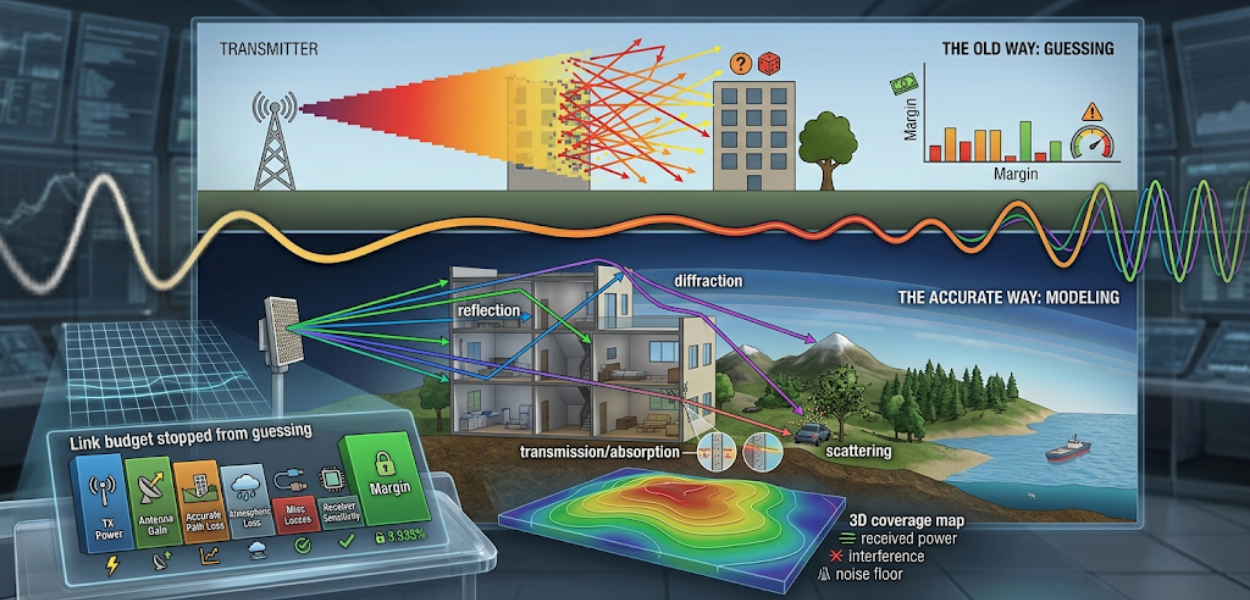
Model Electromagnetic Propagation Accurately and Stop Guessing Your Link Budgets
What Is This Course, and What Problem Does It Solve?
This course addresses a specific technical gap: engineers and technicians who calculate link budgets based on rough assumptions instead of documented propagation models, which produces unreliable network performance predictions. The Arab British Fellowship Training Academy designed this program to close that gap through structured training built on precise specifications.
Wireless frequency planning depends on accurately predicting how a signal travels between a transmitter and a receiver. When link budgets are built on rough estimates instead of sound electromagnetic theory, the consequences surface later: coverage gaps, unexpected interference, and redesign costs. Many technical teams inherit ready-made calculation templates without understanding the physical basis behind the numbers.
Why Was the Course Designed This Way?
The curriculum follows a deliberate sequence: physical principles first, then propagation mechanisms, then calculation methods, and finally applied link budget scenarios, so participants build their computational confidence on a documented theoretical foundation.
Skipping past basic theory straight to calculation shortcuts produces technicians who can operate software tools without being able to diagnose why a prediction went wrong. This course avoids that shortcut. Participants begin with Maxwell's equations as the governing framework for electromagnetic wave behavior, because every propagation mechanism that follows, whether reflection, refraction, or diffraction, is derived from the same physical foundation. After establishing the theoretical basis, the course introduces free-space path loss as a reference model, then adds real-world deviations: multipath interference, terrain obstruction, and atmospheric refraction.
What Will Participants Learn?
Participants gain measurable competency in four areas: applying electromagnetic theory, calculating propagation loss, analyzing obstruction and interference, and building a link budget with documented assumptions.
Module One: Electromagnetic Theory Fundamentals. Participants review Maxwell's equations in applied form, focusing on how they govern wave propagation rather than abstract field theory.
Module Two: Free-Space Path Loss and Deviation Factors. Participants calculate the reference path loss and then identify environmental factors, such as terrain, vegetation, structures, and atmospheric conditions, that cause actual results to deviate from the reference model, in addition to refraction.
Module Three: Multipath Analysis and the Fresnel Zone. Participants learn to calculate Fresnel zone clearance requirements and assess multipath interference risk, and the module includes terrain profile analysis.
Module Four: Wave Polarization and Link Optimization. Participants study how polarization choice affects interference rejection and signal integrity, and apply this understanding to optimize antenna orientation decisions.
Module Five: Applied Link Budget Construction. Participants build complete link budgets from scratch, documenting every assumption and every calculation input, and this module is assessed through a hands-on simulation exercise rather than a written test.
For example, a network operations manager might send a team of four field engineers to this course before executing a rural broadband expansion project, and upon completion, they will be able to independently verify vendor-supplied coverage predictions instead of accepting them without technical review.
How Does the Course Progress?
The training progresses in a blended format that combines structured online modules with live instructor-led sessions, supported by simulation-based practical exercises and downloadable calculation templates.
The online modules cover the theoretical content and let participants progress at a disciplined pace before the live sessions. The live instructor-led sessions focus on applied problem-solving: reviewing calculation errors and working through terrain-based case studies. The course runs over five weeks, one module per week. Organizations enrolling multiple employees can request that the live sessions be delivered on-site, so instructors work directly with the team's existing project data.
What Outcomes Can Be Expected?
Participants demonstrate independent link budget construction competency upon completing the course, verified through an evaluated practical simulation, and organizations typically report fewer design review cycles on subsequent projects.
The most direct outcome is calculation accuracy: participants are assessed on their ability to identify when a software tool's default assumptions are unsuitable for a particular terrain or environment, and to adjust the calculation accordingly. This shifts the technician's role from tool operator to technical reviewer. The second outcome relates to documentation quality, since the applied module requires documenting every assumption, so teams trained together as a group produce more consistent design documentation. The third outcome is diagnostic speed, because engineers trained to trace propagation issues back to their physical cause resolve unexpected performance problems faster.
How Does Enrollment Work?
Enrollment requires a basic understanding of electrical and wave theory, gained either through prior technical education or the academy's own preparatory materials, followed by registration through the course platform and group scheduling.
Individual specialists can enroll independently by selecting one of the published group start dates. Applicants from organizations, whether HR teams or engineering managers, can request a dedicated group with a start date that aligns with project timelines. Enrollment does not require a formal engineering qualification, but participants without prior experience in wave theory are advised to complete the preparatory materials before starting Module One. Upon completing all five modules and the evaluated practical simulation, participants receive a certificate of completion documenting the specific competencies that were assessed.