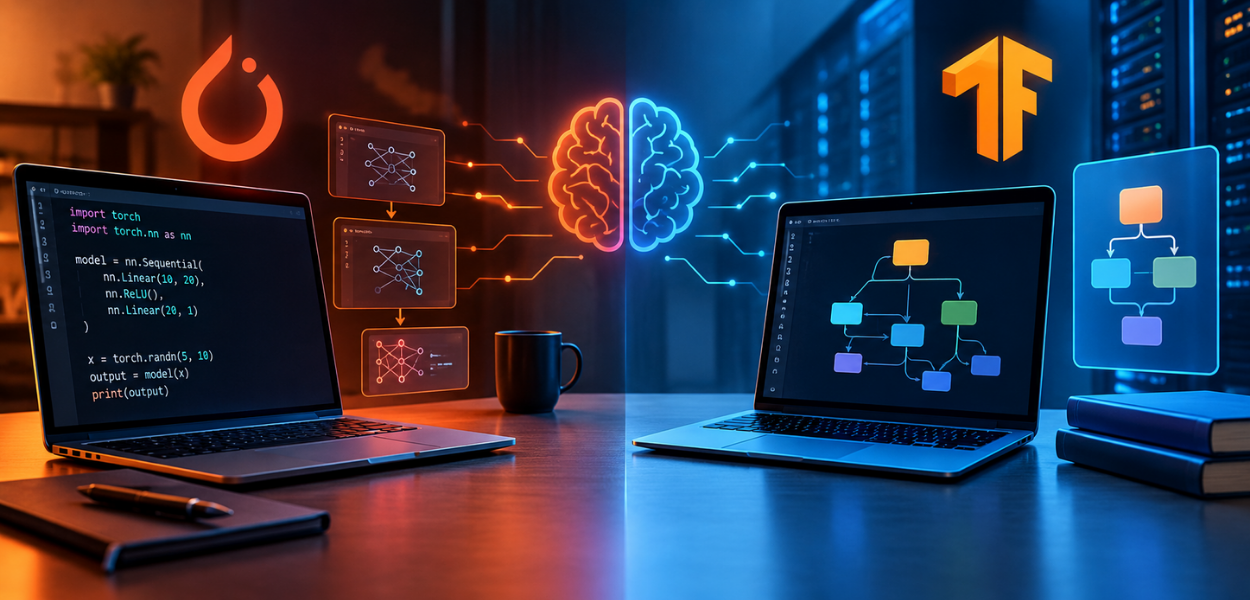
PyTorch and TensorFlow Programming: Eager Execution vs Static Graph Architecture
Choosing between eager execution and static graph architecture affects how deep learning teams build, debug, optimize, and deploy machine learning systems. This distinction becomes especially important when organizations evaluate PyTorch and TensorFlow programming for developing production-oriented workforce skills.
For professionals starting with the fundamentals, PyTorch and TensorFlow programming courses for deep learning provide a broader framework for understanding programming frameworks, model development, tensors, and training pipelines, along with hands-on application. Understanding execution architecture helps technical teams assess which development approach fits their operational requirements.
What is the difference between eager execution and static graph architecture?
Eager execution runs operations immediately as they're written and executed, while static graph architecture defines a computational graph before execution. This distinction affects debugging, model building, optimization, deployment, flexibility, and how deep learning development teams are managed.
Eager execution follows a direct programming model: when you run an operation on a tensor, the framework executes it immediately and returns the result, and developers can inspect tensors, test individual operations, and identify errors during the program's normal execution.
Static graph architecture separates graph construction from execution. Developers define a computational structure representing the mathematical operations and data flow, and the execution system then runs this predefined structure. This distinction affects more than just programming style — it shapes the entire development cycle: a team building experimental neural network architectures benefits from the speed of getting results, while a team deploying repeated workloads within a tuned infrastructure places greater importance on graph optimization and predictable execution.
How does eager execution work in PyTorch?
PyTorch uses eager execution as its natural development model, which allows tensor operations and neural network computations to run immediately. Developers work with the programming flow, inspect intermediate values, and use automatic differentiation while developing and training models.
PyTorch represents numerical data through tensors, a multidimensional data structure that supports the operations needed for neural network computations. When developers run operations on tensors, PyTorch executes them immediately, and the resulting tensors can then be inspected or passed to subsequent operations. This approach integrates naturally with ordinary programming, and conditional statements, loops, functions, and debugging tools work within an environment familiar to developers.
Automatic differentiation provides automated derivative computation. During training, PyTorch tracks the relevant tensor operations and builds the information needed to compute gradients, and backpropagation then uses these gradients to update the model's parameters. This dynamic behavior is useful when neural network architectures change frequently, because developers can test different layers without rebuilding a separate graph definition with every change.
How does TensorFlow use static graph architecture?
TensorFlow supports graph-based execution by representing mathematical operations as a computational structure that can be traced, compiled, optimized, and deployed, which supports disciplined execution, performance optimization, portability, and production-oriented workflows.
TensorFlow historically established a clear distinction between building the graph and executing it. Modern TensorFlow also supports eager execution by default, which makes the development experience more interactive, but it retains powerful graph-based capabilities through mechanisms such as function tracing and graph compilation. The Keras API provides a higher-level approach to building neural networks, so developers can define network layers, configure model architecture, and select optimization algorithms without manually building every computation.
When a TensorFlow function is converted into a graph representation, the framework gets a chance to analyze and optimize the computation, which matters for repeated workloads and deployment environments. For organizations, this distinction becomes important when training teams that need to move from model experimentation to running machine learning in production, because the development environment and the production environment don't always need the same execution pattern.
Why does execution architecture matter in neural network development?
Execution architecture determines how developers work with models, identify errors, control operations, optimize workloads, and prepare systems for deployment. The right approach depends on whether the priority is experimentation, debugging, reproducibility, or computational optimization.
Deep learning development involves repeated experimentation, and developers change neural network layers, adjust parameters, and test different architectures. Eager execution provides immediate feedback after every operation, which makes it easier to investigate unexpected values or isolate errors within the model. Graph-based execution handles the problem differently, because the computational structure provides a representation the framework can analyze and optimize. This distinction matters more as model complexity increases: a small experimental model can tolerate interactive execution, while large production workloads need greater attention to hardware usage, memory behavior, and deployment architecture.
When is eager execution in PyTorch the better fit?
Eager execution suits workflows that need rapid experimentation, interactive debugging, dynamic model behavior, and direct control over execution, and it's especially useful when teams are constantly modifying architectures.
Research and development teams often work with incomplete assumptions — testing a given architecture, examining the results, changing layers, and repeating the process — and direct execution supports this iterative pattern. A developer can inspect a tensor after a given operation without creating a separate execution session, and errors appear close to the operation that caused them. Dynamic model behavior is also an important factor, since some architectures use conditional computation or variable execution paths, and eager execution handles these patterns using ordinary programming constructs.
When is TensorFlow's graph-based execution the better fit?
It matters most when teams prioritize repeated computation, optimization, deployment workflows, hardware utilization, and disciplined production environments, because graphs provide a structured computational model that supports transformation and optimization.
Production machine learning systems run repeatedly on large datasets or high volumes of inference requests, and graph representation provides a structured view of the computation that enables optimization opportunities that are difficult to apply if every operation is treated only as an immediate interactive instruction. The Keras API adds an extra layer of abstraction that lets teams build models from reusable components. For organizations managing multiple technical teams, this standardization carries measurable operational value in documentation, onboarding new staff, and code review.
How do PyTorch and TensorFlow compare on debugging and development speed?
PyTorch generally offers a more direct debugging experience through eager execution, while TensorFlow offers both interactive development and graph-based execution together. The practical difference depends on model complexity, team experience, and deployment requirements.
With eager execution, developers can inspect intermediate tensors and trace the execution path directly, and debugging tools integrate naturally with this process. Modern TensorFlow's development experience also supports eager execution, which narrows the historical gap between the two frameworks. Training teams should assess how quickly staff can complete defined tasks, such as building a neural network, implementing backpropagation, diagnosing a tensor-dimension error, training on a GPU, and evaluating model performance, since this provides stronger evidence than personal preference.
How should organizations choose the right execution approach?
Technical teams need to assess model complexity, development iteration frequency, debugging requirements, deployment goals, GPU workloads, team experience, and reproducibility, and the execution approach needs to align with the full machine learning lifecycle.
The first consideration is development behavior: teams running repeated experiments need flexibility and speed, while teams managing standardized production pipelines need predictable, optimized execution. The second consideration is deployment: a model intended for a disciplined production environment differs from an experimental research model. The third consideration is workforce capability, because advanced technical architecture won't produce better results if staff lack the skills needed to use it effectively. The fourth consideration is infrastructure, since GPU acceleration can significantly reduce training time, though the outcome depends on the workload's characteristics. For structured training programs that connect development knowledge to production application, the Arab British Fellowship Training Academy's IT and programming courses provide a suitable resource for this decision-making stage.