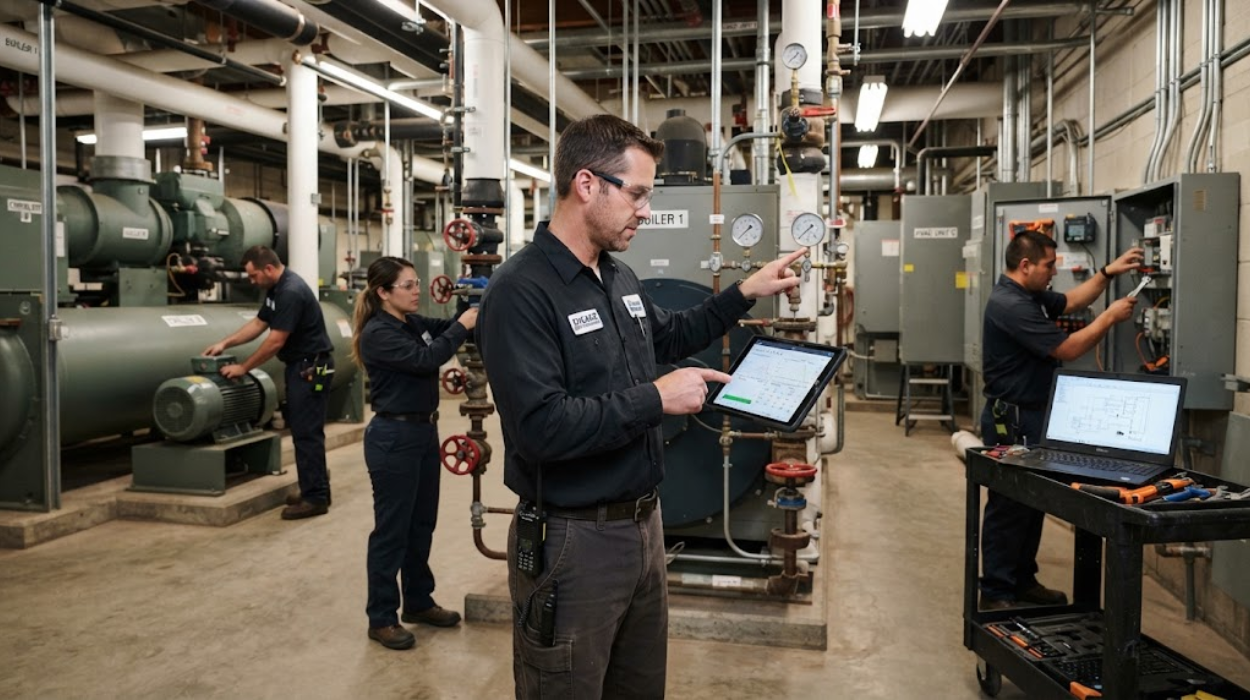
Building Maintenance Explained: Preventive, Predictive and Corrective
Building maintenance is the planned management of the assets, systems, equipment, and physical facilities that support an organisation's daily operations. It covers preventive, predictive, and corrective maintenance, and each approach addresses a different type of operational risk, maintenance cost, and equipment failure.
For organisations, maintenance is a professional capability as much as it is a technical function. The facilities manager, maintenance engineer, technician, supervisor, and operations team all need defined procedures, technical knowledge, safety awareness, and clear performance metrics. Effective maintenance programmes link asset condition to business continuity, workplace safety, energy performance, compliance, and operational productivity.
What is building maintenance in a corporate setting?
Building maintenance is a systematic process of inspecting, servicing, monitoring, repairing, and improving facilities and assets, in order to maintain a safe, reliable, compliant, and productive work environment. It covers buildings, electrical systems, heating, ventilation and air conditioning, plumbing, fire protection, elevators, structures, and supporting infrastructure. Requirements vary by setting — an office, a hospital, a hotel, an industrial facility, a warehouse, a school, or a data centre — each with different priorities for asset criticality, operating conditions, and safety.
A corporate maintenance programme starts with an asset register that identifies equipment, its location, specifications, operating condition, service history, and criticality level (based on its impact on safety, operations, revenue, and compliance). Maintenance teams then set work procedures for inspection, servicing, repair, testing, and reporting, which defines responsibilities and standardises criteria across different departments and sites.
Any skills gap in electrical maintenance, mechanical systems, HVAC systems, safety, fault diagnosis, or documentation creates real operational vulnerabilities, which is exactly why structured training matters so much here.
How do preventive, predictive, and corrective maintenance work?
- Preventive maintenance: planned activities carried out at set intervals, based on time, operating hours, usage levels, or manufacturer instructions, to reduce the likelihood of failures. Examples: replacing air conditioning filters every three months, testing fire alarm devices monthly, and inspecting electrical panels annually.
- Predictive maintenance: uses measurable condition data to identify deterioration before a failure occurs. Technicians gather information through vibration analysis, thermal imaging, oil analysis, pressure measurements, or energy consumption monitoring. Any change in operating condition triggers an immediate inspection before the fault grows.
- Corrective maintenance: responds to a specific defect or failure after it has occurred. The team diagnoses the fault, isolates the hazards, carries out the repair, tests the asset, and records the outcome.
The three approaches work together as an integrated maintenance strategy: preventive maintenance controls known deterioration patterns, predictive maintenance identifies risks linked to equipment condition, and corrective maintenance addresses unexpected or unavoidable defects. The choice depends on the criticality of the asset and the consequences of its failure — a hospital's backup power system needs much stricter controls than a non-essential light fitting in a storeroom.
What are the core components of an effective maintenance programme?
- Asset management: classifying equipment by function, condition, replacement value, and operational criticality.
- Maintenance planning: turning asset information into scheduled activities — task frequency, labour required, spare parts, tools, permits, and expected completion times.
- Work order management: every work order identifies the asset, the issue, the priority, the assigned technician, the resources required, and completion status.
- Safety procedures: isolation procedures, work permit systems, electrical safety, working-at-height requirements, confined space controls, and personal protective equipment.
- Condition monitoring: inspection and sensor data that supports predictive maintenance.
- Documentation: records showing what was inspected, what was repaired, which parts were replaced, who carried out the activity, and when.
Training links these systems to actual staff capability: case-based learning lets an employee analyse real maintenance failures, simulation reproduces technical scenarios without disrupting actual assets, and interactive exercises build communication between technicians, supervisors, contractors, and facilities managers.
How does an organisation deliver effective building maintenance training?
- Assess the skills gaps: review maintenance records, audit reports, incidents, recurring equipment failures, and employee competency data.
- Define the learning requirements: a maintenance engineer needs different technical competencies than a facilities supervisor or a procurement manager, and learning objectives need to link to actual job responsibilities.
- Choose the delivery method: collaborative problem-solving workshops, online modules for theoretical learning, blended learning, or on-site sessions for direct exposure to the facility's actual systems.
- Apply practical methodologies: analysing maintenance cases, practising fault diagnosis, taking part in simulations, and training on maintenance planning.
- Transfer the learning to work procedures: actually applying inspection schedules, work order procedures, and risk controls in the workplace.
- Measure the results: compare performance indicators before and after training — adherence to planned maintenance, mean time to repair, equipment downtime, recurring failures, and maintenance cost.
What are the benefits of structured maintenance training?
Structured training improves consistency of procedures, technical decision-making, safety controls, asset reliability, and the quality of work orders. Employees follow defined procedures instead of relying on inconsistent individual practices, planning improves resource allocation before work starts, and safety performance improves when employees properly understand isolation procedures, risk assessment, and permit systems.
Accurate maintenance data also improves management decisions — work orders and asset records reveal recurring failures and inefficient processes, and reliability improves when the organisation addresses root causes instead of repeatedly treating symptoms. Financial performance is measured by tracking unplanned downtime, overtime, spare parts consumption, contractor costs, and asset replacement costs.
Where is building maintenance training applied within organisations?
- Facilities teams: planned maintenance, contractor coordination, compliance monitoring, and asset record keeping.
- Engineering teams: reliability of equipment and technical systems such as mechanical, electrical, HVAC, pumps, and generators.
- Operations teams: because equipment availability directly affects production and service delivery, especially at industrial sites, warehouses, and data centres.
- Health and safety teams: risk assessment, inspections, and incident prevention.
- Procurement teams: selecting service providers, spare parts, and maintenance contracts based on a genuine understanding of technical requirements.
Senior executives use maintenance indicators to assess operational risk and investment priorities, particularly when asset failures affect customers, production, revenue, or reputation.
What common problems reduce the effectiveness of building maintenance?
- Relying only on responding to failures: the team responds after a failure occurs instead of controlling predictable deterioration, which increases emergency work and overtime.
- Incomplete asset records: without accurate information on equipment condition and criticality, a manager can't reliably prioritise maintenance.
- Generic training: a programme that ignores the organisation's actual assets, job responsibilities, and safety procedures won't address the real competency gaps.
- Training without evaluation: attending training alone doesn't prove competency — it needs assessments, practical exercises, and comparison against real performance indicators.
- Weak contractor management: requires clearly defined scope of work, competency requirements, safety expectations, and service-level metrics.
How does an organisation measure maintenance training outcomes?
Measurement happens at several levels: the learning level (does the employee understand the principles, procedures, and terminology?), the application level (are they correctly applying inspection procedures and work order standards?), and the operational performance level (comparing indicators before and after implementation).
- Adherence to planned maintenance: the percentage of scheduled tasks completed on time.
- Mean time to repair: the time needed to bring an asset back into operation after a failure.
- Recurring failure rate: assets that keep experiencing repeated issues after maintenance.
- Maintenance backlog: the volume of outstanding work, where a persistent backlog signals a capacity shortfall or poor planning.
Return on training investment links financial investment to measurable operational outcomes — comparing training costs against reduced downtime, lower emergency repair expenses, and improved productivity.
How does maintenance training support long-term workforce development?
A competency framework defines the knowledge and skills required for each maintenance role: technical competencies such as electrical, mechanical, and HVAC systems, asset management, and diagnostics, and supervisory competencies such as scheduling, resource allocation, contractor management, and performance indicator analysis. Standardised learning reduces knowledge variation between employees and sites, and structured competency data supports succession planning — identifying employees who've shown genuine readiness for greater technical or supervisory responsibility.
Long-term development requires ongoing evaluation, because maintenance technologies, monitoring systems, and energy requirements keep changing over time. A practical organisational approach links learning design to maintenance strategy, and the result is a workforce that understands not just how to carry out maintenance tasks, but how those tasks affect reliability, safety, cost, compliance, and business continuity.