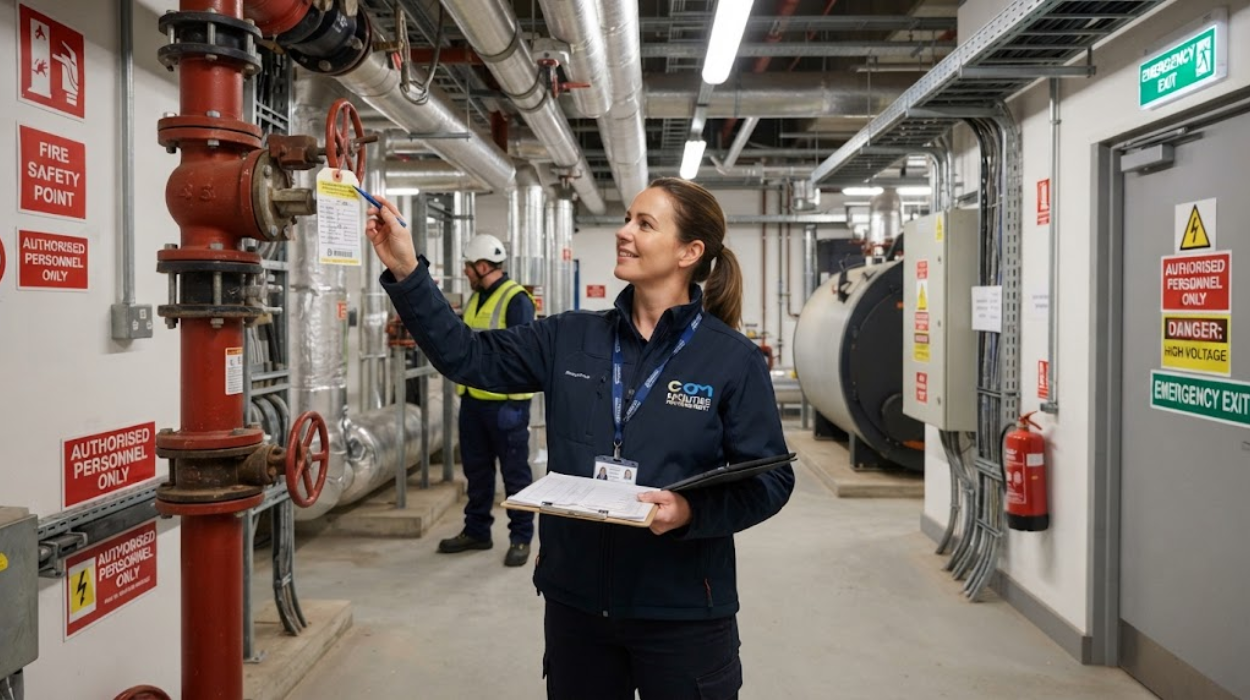
Health and Safety in Facility Management: Duties and Standards
Health and safety in facility management is a structured responsibility covering people, buildings, equipment, contractors, maintenance work, and working conditions. Effective facilities management links legal duties, risk management, competent staff, planned maintenance, and ongoing monitoring within one integrated operational system.
Facility management decisions also depend on how responsibilities, competencies, and evaluation standards are defined within service delivery itself, and understanding the broader procurement context helps connect safety requirements to contractor selection, tender evaluation, and operational accountability.
What are the core health and safety duties in facility management?
A facilities manager is responsible for establishing practical controls that protect employees, contractors, visitors, and anyone affected by facility operations, while ensuring risks are assessed, responsibilities are defined, maintenance is managed, and legal requirements are monitored continuously. A facilities manager doesn't necessarily carry out every technical safety task personally, but ensures proper arrangements are in place and that risk is managed by qualified people.
In the UK, for example, the Health and Safety at Work Act 1974 imposes general duties on employers, and there are also specific duties on people in control of non-domestic premises toward those who use them. The Workplace Regulations 1992 cover basic working conditions such as ventilation, temperature, lighting, cleanliness, space, traffic routes, and welfare facilities. The Management of Health and Safety at Work Regulations 1999 add administrative requirements such as carrying out adequate risk assessments, and arrangements for planning, organizing, monitoring, and reviewing preventive measures.
For the facilities management department, these duties translate into actual operational controls: defined responsibilities, documented procedures, qualified staff, inspection schedules, maintenance programs, contractor controls, and an incident-reporting system.
How does risk assessment support safety in facility management?
Risk assessment provides a decision-making process by identifying hazards, evaluating them, choosing controls, and reviewing their effectiveness across buildings, assets, maintenance work, contractors, emergency arrangements, and daily activities. It starts by identifying hazard sources such as electrical systems, fire, asbestos, legionella, working at height, confined spaces, hazardous materials, and slip and trip risks.
Next comes identifying who might be harmed and how - the levels vary between employees, contractors, visitors, and customers. Controls are then chosen based on the level of risk: engineering controls, physical barriers, maintenance procedures, restricted access, training, and personal protective equipment. Risk assessments need periodic review, because any new system, new contractor, or new maintenance method can change the level of risk.
An effective health and safety management system relies on leadership, worker involvement, competence, legal compliance, and hazard identification. The plan-do-check-act approach helps organize continuous improvement in safety management.
What standards and regulations affect facility management safety?
There's no single standard covering all safety responsibilities in facility management, so a facilities manager works across multiple regulatory and technical areas. Workplace regulations provide basic working-condition requirements, and other requirements apply to specific activities such as working at height, fire, hazardous materials, asbestos, electrical work, and lifting equipment. Technical standards support consistency in maintenance work and building management, with some providing guidance for facilities maintenance management and others covering access equipment and structures.
That's why a facilities manager needs a compliance register identifying every requirement, who's responsible for it, inspection frequency, required evidence, and procedures for addressing non-compliance.
How do you manage contractors and maintenance teams safely?
Contractor safety depends on defining responsibilities, competency checks, risk controls, method statements, communication, supervision, permit-to-work systems, and performance monitoring - from contractor selection through to work completion and review. Contractors introduce additional risk because the facilities manager doesn't directly control their workforce, so requirements need to be defined before any work begins.
Initial contractor vetting should cover competence, relevant experience, insurance, training, safety record, and technical capability - proportionate to the risk level of the activity. Higher-risk work needs stronger controls and clearer communication. Permit-to-work systems are especially important for activities such as hot work, confined space entry, and certain electrical work.
Contractor performance should be monitored continuously through indicators such as completed inspections, overdue corrective actions, incident rate, recurring defects, and the completion rate of planned maintenance. This links safety to procurement: contractor evaluation isn't just a commercial process, because their safety management competence directly affects their ability to deliver a reliable service.
What competencies does a facility management specialist need?
Competence isn't just completing a training course - it's a combination of knowledge, skills, experience, and behaviors needed to carry out responsibilities effectively:
- Sufficient technical understanding: to recognize hazards in building services and maintenance work, not necessarily performing every technical task personally, but knowing when specialist expertise is needed.
- Risk management: identifying hazard sources, understanding appropriate controls, and reviewing weak or incomplete assessments.
- Contract management: defining scopes of work, service requirements, performance indicators, and safety expectations.
- Communication: instructions must be understood by employees, contractors, and stakeholders.
For HR teams, training should address specific competency gaps identified through risk assessments, audits, incidents, performance reviews, and actual operational changes.
How does an organization evaluate health and safety performance in facility management?
Evaluation should use measurable indicators covering compliance, risk controls, maintenance, incidents, corrective actions, contractor performance, and staff competence, not just training attendance. A strong measurement system combines lagging indicators (actual incidents, injuries, and damage) with leading indicators (completed risk assessments, safety inspections, planned maintenance completion, and closure of corrective actions).
- Planned preventive maintenance completion rate
- Mandatory inspection completion rate
- Number of open and overdue corrective actions
- Contractor safety audit results
- Safety training completion
- Incident and near-miss reporting
- Recurring maintenance defects
- Emergency drill performance
The value of these indicators comes from trend analysis - a single month's result gives limited information, but a six-to-twelve-month trend shows whether controls are genuinely improving or declining.
How does maintenance affect health and safety?
Maintenance protects safety by keeping building systems, equipment, and infrastructure in proper working condition, reducing the risk of failures, and supporting compliance. A poorly maintained ventilation system can affect indoor environmental conditions, faulty electrical equipment can cause electrical hazards, and a disabled fire protection system can weaken emergency procedures.
Facilities teams usually manage more than one maintenance approach: preventive (on planned intervals), predictive (based on condition data), corrective (for identified defects), and reactive (after a failure occurs). The appropriate approach depends on asset criticality, the consequences of failure, operating conditions, and regulatory requirements, and asset-criticality classification helps prioritize - a high-criticality fire protection system needs a completely different maintenance strategy from a low-consequence asset.
How do you choose the right training for health and safety responsibilities?
The choice should be based on specific competency gaps, job responsibilities, operational risks, and required outcomes, evaluating the training method through practical application, knowledge retention, and measurable performance. A facilities manager may need broader knowledge of risk, compliance, and contractor management, an engineer needs stronger technical competence, and a supervisor needs practical skills in safe work control and workforce communication.
The assessment method matters a great deal: a training-completion certificate only proves participation, not actual competence in the workplace. The strongest assessment measures knowledge, application, and operational outcomes, such as improved audit results, fewer overdue corrective actions, better maintenance compliance, and higher contractor performance.
What should an organization evaluate before choosing a training program?
- Relevance: does the program address the target team's actual responsibilities, rather than generic safety information?
- Practical application: do participants work through realistic scenarios covering risk assessment, contractor controls, and incident management?
- Competency coverage: does it cover the technical, managerial, and behavioral capabilities the job requires?
- Measurement: how will learning impact be assessed after training ends?
- Organizational integration: is the training linked to your actual risk registers, maintenance systems, and contractor procedures?
How does HR measure the business impact of safety training?
Useful measurement links learning outcomes to workplace indicators: competency assessments, audit results, maintenance compliance, corrective-action closure, contractor performance, and incident trends. The strongest model starts with baseline data before training, and after training, the same indicators are reviewed at defined intervals - such as comparing mandatory maintenance completion rates before and after, overdue corrective actions, or the quality of risk assessments.
What does an effective health and safety framework for facility management look like?
An effective framework links legal compliance, risk assessment, competent people, safe maintenance, contractor management, working conditions, emergency preparedness, performance measurement, and continuous improvement - within one operational system. Strong frameworks don't treat safety as a separate administrative function, but integrate it into procurement, maintenance, asset management, workforce planning, and daily operations.
Responsibilities need to be clear at every level: managers put the right arrangements in place, qualified specialists manage the technical requirements, supervisors control work activities, and employees and contractors follow procedures and report hazards. Evidence supports the whole system: risk assessments, inspection records, maintenance records, training records, and incident reports - creating a continuous cycle of plan, do, check, act.
For organizations comparing different facility management capabilities, the real question isn't just whether a safety procedure exists on paper, but whether people, processes, assets, and suppliers actually continue to operate within defined controls, and whether management can demonstrate the effectiveness of those controls with evidence.